
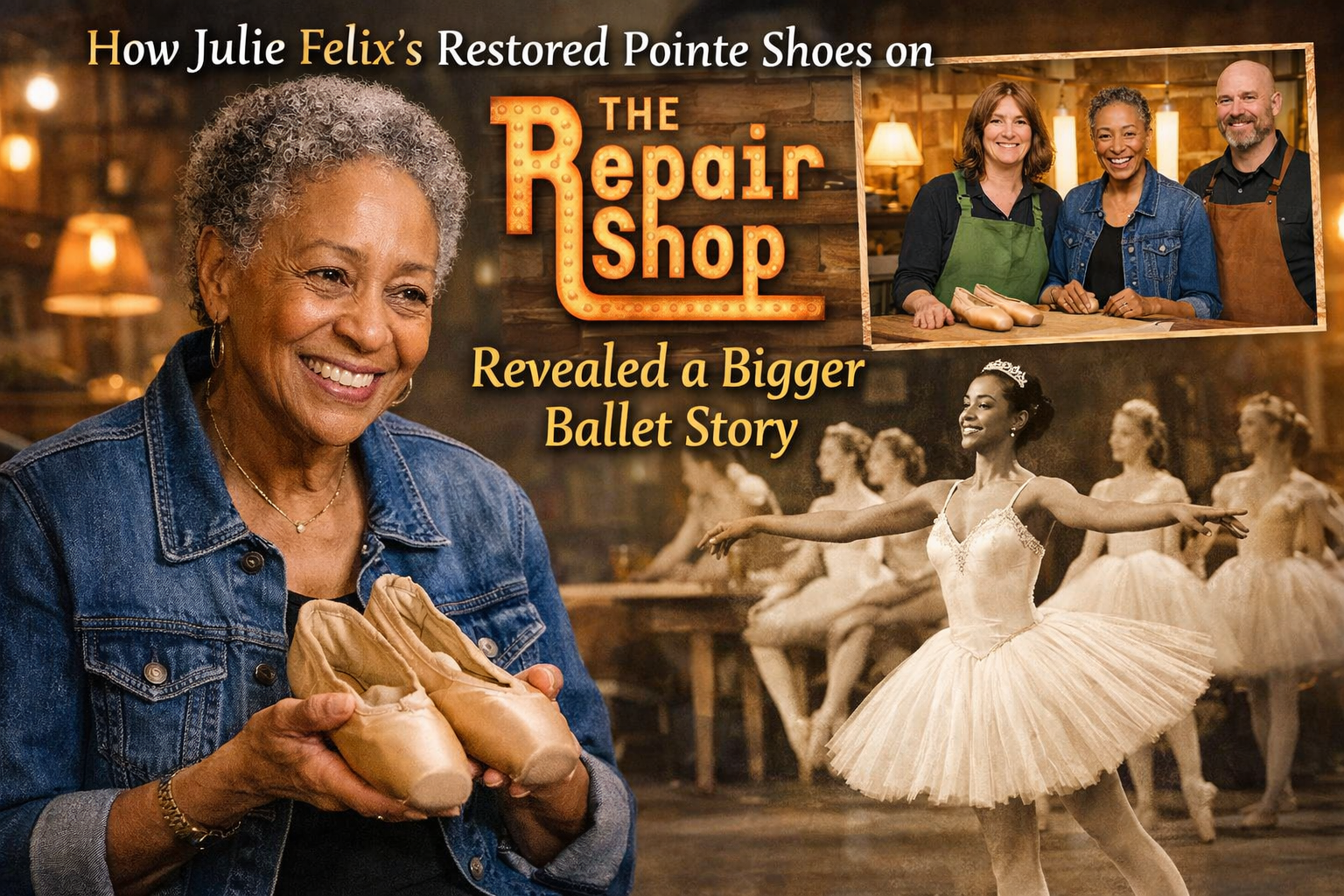
There are some The Repair Shop stories that feel gentle at first and then keep unfolding after the episode ends. Julie Felix’s was one of those. On the surface, it was about a pair of old pointe shoes being carefully restored. On a deeper level, it was about memory, race, ambition, family, and the way a single object can hold a whole career inside it. Felix said she felt “winded” and “breathless” when she saw the shoes brought back to life. That reaction was not really about fabric and glue. It was about what those shoes had survived, and what she had survived with them.
That is why this story deserves more than a quick television recap. Julie Felix is not just another guest on a well-loved BBC format. She is widely recognised as Britain’s first professional Black ballerina, and the outline of her career has been documented by institutions including The Royal Ballet School, Falmouth University, and the Black British Ballet project by Oxygen Arts. Put simply, her appearance on The Repair Shop was not just emotional television. It was a small act of public remembrance around one of the women who forced open a door that British ballet had long kept shut.
What happened on The Repair Shop with Julie Felix
According to PA Media’s report on the episode, Felix brought in the ballet shoes she wore during her first professional solo performance around 40 years ago. She told the programme’s experts, Lucia Scalisi and Dean Westmoreland, that these were the shoes she wore when her mother and father came to see her perform on the stage of the Royal Opera House. The shoes were tan-coloured, dyed to match her skin tone, and they had become deeply bound up with her memory of finally arriving at a place she had fought to reach.
That detail matters more than it might seem. In ballet, shoes are practical objects, almost brutal ones, shaped by pressure, sweat, rehearsal, pain, repetition. But these shoes also became symbolic. Felix described them as carrying “all the work, effort, love and devotion” from her mother. That shifts the whole story. We are not watching someone restore a costume relic from a performing career. We are watching a daughter revisit the proof of a promise kept — not perfectly, not easily, but fully enough that her parents could see her on that stage and know she had made it.
And then there is the timing of it all. PA Media reported that Felix reflected not only on the sentimental weight of the shoes, but also on the barriers she had faced before that moment ever became possible. She spoke about being pushed towards the United States in the 1970s after a London ballet company excluded her because of the colour of her skin. So when viewers saw her react to the restored shoes, they were also seeing the return of a difficult chapter in British cultural history — one that was never only personal, even if it was experienced in deeply personal ways.
Who Julie Felix is, beyond the headlines
It is worth slowing down here, because a lot of coverage jumps quickly from “first Black ballerina” to the touching TV moment. But Julie Felix’s actual career is what gives the television appearance its force. The Royal Ballet School says Felix was a dedicated Rambert student who, in 1975, was selected to dance in Rudolf Nureyev’s production of Sleeping Beauty for London Festival Ballet, now English National Ballet. That should have been the kind of opportunity that leads naturally into a national-company career. Instead, as the School recounts, she was met with racist comments about how her skin would “mess up the line” of the corps de ballet.
That sentence is ugly. It is also historically important, because it strips away the comfortable myth that talent always rises cleanly in elite arts institutions. It often does not. Felix had ability, training, momentum, and still encountered a closed gate. The Royal Ballet School’s profile makes clear that she did not simply disappear after that rejection. She chose not to sink. She went on to join Dance Theatre of Harlem after the company came to London and offered her a contract. That move changed the direction of her life.
The Birmingham Hippodrome’s page for A Celebration of Black British Ballet places her joining Dance Theatre of Harlem in 1977 and notes that she returned to the UK after ten years, later becoming a teacher at Sadler’s Wells Royal Ballet and then Birmingham Royal Ballet. Falmouth University, in marking her MBE, says her career included performances for major public figures and artists and extended into company teaching, remedial coaching, lecturing and dance education. So the Julie Felix story is not a one-night triumph in a pair of shoes. It is a long arc: denied at home, recognised abroad, then returned as a teacher and guide inside the very world that once tried to narrow her future.
That later chapter matters just as much as the breakthrough years. Too often, stories about pioneers freeze them at the moment of firsts, as if the whole point is simply that they crossed a line first. But Felix’s legacy is bigger than that. She did not only become visible herself; she helped teach, coach and shape others. In 2024, that contribution was formally recognised when she was appointed MBE for services to dance education, a fact confirmed both by the official New Year Honours List and by Falmouth University. The honour does not invent her significance. It simply makes public what many in dance already knew.
Why the shoes carried so much weight
The easy version of the story is that Julie Felix cried because an old treasured object came back looking beautiful. That is true, but it is incomplete. The stronger reading is that the shoes carried at least three layers at once.
The first layer was familial. PA Media’s account makes clear that Felix’s mother was her biggest supporter, and that her mother had wanted the shoes repaired and displayed in the house as a memory of seeing Julie perform at the Royal Opera House. In that sense, the restoration did not just preserve footwear. It fulfilled a family wish that had stayed emotionally unfinished for years.
The second layer was professional. Those shoes were tied to Felix’s first solo performance at the Royal Opera House — a moment that symbolised arrival after exclusion. It is one thing to hear that someone eventually succeeded. It is another to see the actual item from the night it happened, the material evidence of a breakthrough that did not come cheaply. The shoes become a compact archive of labour: training, rejection, travel, reinvention, and then performance.
The third layer was cultural. Once you place Julie Felix within the wider history of Black British ballet, the shoes stop being only hers. They become part of a public story about who is seen in classical dance, who is erased from it, and who gets remembered properly later on. The Black British Ballet project, based on the PhD work of Dr Sandie Bourne, argues that Black British dance professionals remain significantly underrepresented and that their absence reinforces the idea for some communities that ballet is not “for them.” That is a powerful frame for understanding why a televised restoration could resonate so widely. The object is personal; the symbolism is collective.
The bigger history behind this one television moment
One reason the The Repair Shop Julie Felix story struck such a nerve is that it arrived at a time when institutions have started, finally, to acknowledge how incomplete ballet history can look when told from the centre outward. The Black British Ballet project exists precisely because the presence and contribution of Black artists in British ballet were too often ignored or pushed to the margins. On its own site, Oxygen Arts says Black dancers have been present in British ballet since at least the 1940s, but that their stories were largely overlooked, and that many dancers who trained in mainstream institutions in the 1970s were effectively forced to seek work abroad. Julie Felix is part of that pattern, not an exception floating above it.
That context changes how we read the rejection she described. It was not just one cruel comment from one bad moment. It reflected a system of assumptions about what ballet should look like and who belonged in its visual order. When Felix was told that a Black dancer would disrupt the line of the swans, the issue was not merely prejudice in a social sense. It was also an aesthetic rule masquerading as neutral tradition. That kind of exclusion is especially hard to challenge because it hides behind the language of beauty, line, harmony, style. The Royal Ballet School’s profile and the Black British Ballet project both help expose that history for what it was.
Dr Sandie Bourne’s work is especially important here because it gives scholarly structure to what might otherwise be dismissed as isolated anecdote. On the Black British Ballet site, Bourne says underrepresentation reinforces the perception that ballet is not “for them” among those with little relationship to the art form. That insight travels well beyond dance. It explains why stories of pioneers matter. If people never see themselves in an art form’s past or present, the barrier is not only practical; it becomes psychological too. Visibility is not everything, but invisibility does real damage.
Marsha Lowe, Director of Oxygen Arts, adds another layer. Writing about the exhibition Into the Light: Pioneers of Black British Ballet, she said the goal was to give Black British pioneers the recognition they deserve and encourage the next generation of young Black dancers to see ballet as “for them.” That is not empty inclusion language. It is a statement about cultural inheritance. Young dancers need technique, training and access, of course. But they also need lineage. They need to know that someone came before them, fought, worked, left traces, and should not be forgotten.
Why The Repair Shop was actually a good format for this story
It is easy to underestimate programmes like The Repair Shop because they look soft around the edges. But that softness is part of the format’s strength. The show deals in ordinary objects, domestic memory, handmade repair, and quiet listening. In Felix’s case, that turned out to be exactly the right frame. A louder, more conventional documentary approach might have leaned too hard on “trailblazer” rhetoric and flattened her into a symbol. The Repair Shop did something subtler. It let the object lead. And because the object was so emotionally loaded, the history came through without needing to be oversold.
That matters because heritage is often easier for audiences to absorb when it arrives through something tactile. A pair of old pointe shoes says things that a headline cannot. You can see age in them. You can imagine strain. You can feel how small they are compared with the scale of what they carried. When the repair experts handled them, viewers were not only hearing that Julie Felix mattered. They were seeing, almost in miniature, how fragile the evidence of a groundbreaking life can be if nobody decides to care for it.
There is another reason the format worked. Felix’s story contains pain, but it is not reducible to pain. She was denied opportunity in Britain, yes, but she also built a serious international career, taught at the highest levels, and later received an MBE. The Repair Shop held both truths in the same frame: injury and achievement, hurt and pride, struggle and survival. Good storytelling should be able to do that without turning a person into either a victim or a saint. This episode came unusually close.
What makes this story relevant now
One reason this story still lands is that representation debates can become abstract very quickly. People start talking in numbers, panels, policies, targets. Those things matter. But then a story like Julie Felix’s arrives and reminds people that exclusion is not abstract when you are the one standing in the rehearsal room being told you disturb the line. Nor is recognition abstract when the thing being recognised is something your mother wanted preserved in the house because it meant the world to her.
It is also relevant because British institutions have spent the past few years doing more public work around historic exclusion in the arts. The Royal Ballet School’s profile of Felix, the Oxygen Arts and Black British Ballet projects, the Birmingham event around Black British ballet, and the formal recognition of Felix’s educational contribution all point in the same direction: there is now a clearer willingness to name what earlier generations were forced to absorb in silence. That does not erase the past. It does, however, make a different future slightly more possible.
Still, it would be too neat to pretend the work is finished. Oxygen Arts has argued that Black British dancers remain underrepresented, and its project exists because these histories are still not widely known enough. So the Felix episode should not be treated as a feel-good endpoint. It is better understood as a reminder — a moving one, yes, but still a reminder — that cultural repair is slower than object repair. A pair of shoes can be restored in a workshop. A tradition takes longer to mend.
Final takeaway
So, what was The Repair Shop Julie Felix story really about?
Yes, it was about ballet shoes. Yes, it was about a mother’s love and a daughter’s gratitude. But the bigger truth is that it was about what happens when a small physical object becomes a carrier of public history. Julie Felix’s shoes were worn during a moment of personal triumph, but that triumph only makes full sense when placed against the racism that sent her abroad, the career she built anyway, the teaching work she gave back later, and the larger story of Black British ballet that researchers and arts organisations are still trying to document properly.
That is why the episode stayed with people. It was not nostalgia dressed up as importance. It was importance, revealed through nostalgia. A restoration show fixed a pair of shoes, and in doing so briefly restored attention to one of the dancers who changed what British ballet could look like. That is a smaller sentence than it deserves, really. But maybe that is fitting. The shoes were small too. The life inside them was not.
Expert Rx: Do not frame Julie Felix’s The Repair Shop appearance as a soft TV anecdote and leave it there. The strongest editorial angle is legacy: a restored object that opens into questions of heritage, exclusion, artistic memory, and who gets properly written into British cultural history. Dr Sandie Bourne’s research and Marsha Lowe’s public comments show that Felix’s story belongs inside a bigger conversation about representation in ballet, not outside it.
Reference
PA Media – ballerina breathless after Repair Shop experts restore shoes
The Royal Ballet School – Black History Month / Julie Felix context
Birmingham Hippodrome – A Celebration of Black British Ballet
Falmouth University – Honorary Fellow awarded MBE in New Year Honours List
GOV.UK – New Year Honours List 2024 PDF
Black British Ballet – New exhibition celebrates ballet’s Black pioneers