
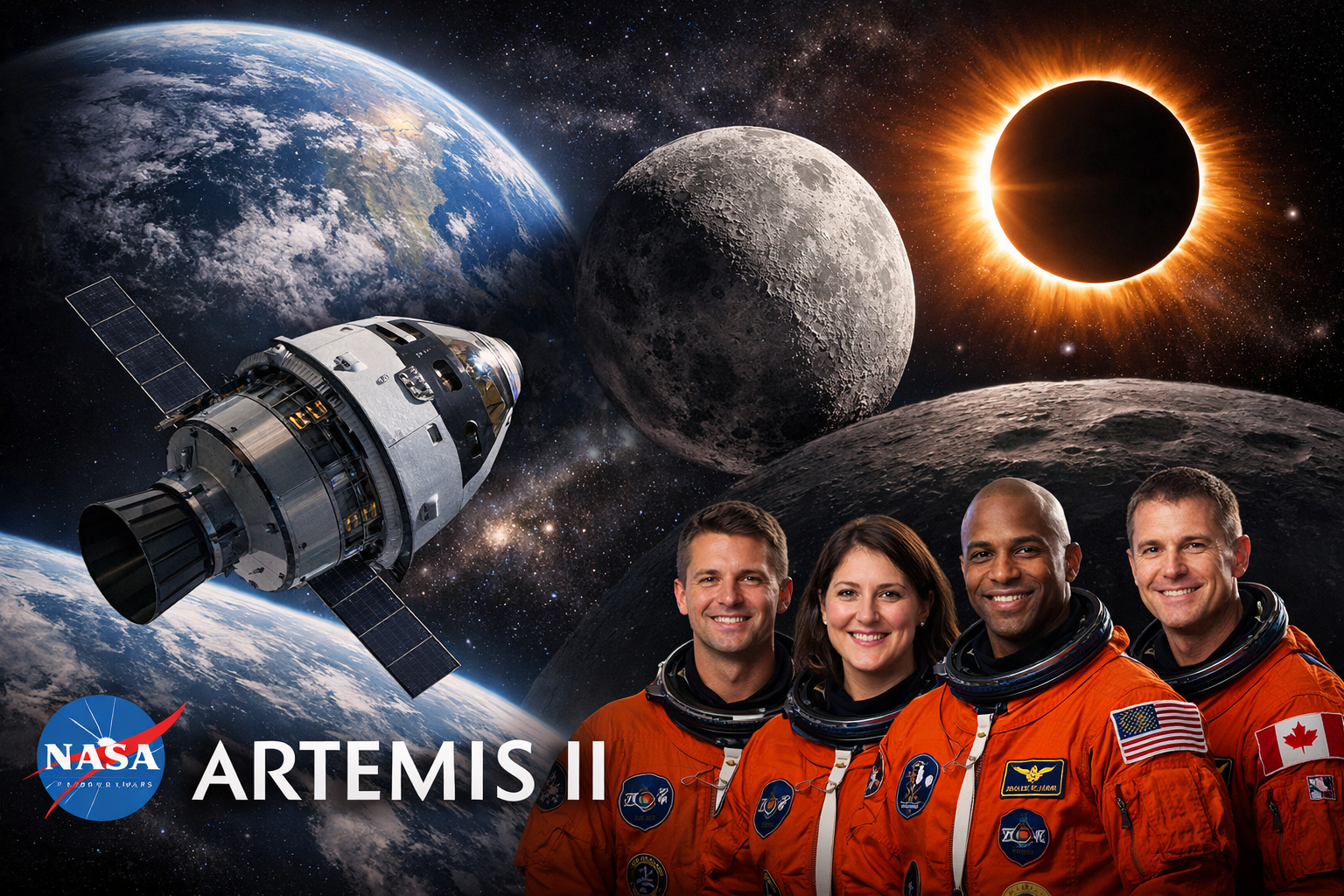
For a long time, Artemis II lived in headlines as a promise. A date to watch. A crew to remember. A mission that would matter later.
That has changed.
As of Wednesday, 8 April 2026, Artemis II is not a future-tense story anymore. NASA launched the mission on 1 April 2026, sending Reid Wiseman, Victor Glover, Christina Koch, and Jeremy Hansen aboard Orion on the first crewed Artemis flight and the first human mission to travel around the Moon in more than 50 years. NASA describes it as a roughly 10-day test flight built to prove the deep-space systems needed for later lunar missions.
That description sounds neat and technical, but it undersells the mood of this mission. Artemis II is not just ticking boxes. It is doing the hard work of turning a long-term Moon programme into something real, visible, and harder to dismiss.
The update that matters most
The mission crossed into a different category on 6 April 2026, when Orion completed its lunar flyby. NASA said the crew surpassed the old Apollo 13 mark for the farthest distance humans had travelled from Earth, crossing 248,655 miles and later reaching about 252,756 miles at the mission’s farthest point. NASA also said Orion came to roughly 4,067 miles above the lunar surface during the flyby.
That is the headline update, but it is not the whole point. Records are memorable because they sound dramatic. Programmes survive because the machinery works.
NASA’s update after the trans-lunar injection burn made that clear. The agency said Orion successfully completed the key burn that sent the crew out of Earth orbit and on course for the Moon, which matters because this is the first time astronauts have flown that profile aboard Orion in deep space.
The images gave the mission a public face
The most human part of the mission may be the imagery now coming back.
NASA released official lunar flyby photographs on 7 April 2026, saying the crew spent around seven hours observing and photographing the Moon’s far side. The agency highlighted views including an earthrise, an earthset, and a rare look at a solar eclipse from deep space. NASA’s chief exploration scientist Jacob Bleacher said the sharper images coming down were finally revealing the scientific value the crew had been describing during the flyby.
That feels important for a reason beyond beauty. Space programmes always need one set of facts for engineers and another for the public. The technical milestones tell you whether the mission is working. The images tell everyone else why they should care.
Why Artemis II is more than a rehearsal
There is a lazy way to talk about missions like this. If astronauts do not land, some people assume the flight is only a warm-up. Artemis II does not fit that frame very well.
NASA’s own mission overview says the purpose is to test the Space Launch System, the Orion spacecraft, and the crewed deep-space operations behind them before later missions push further into the Artemis campaign. That includes not just the ride to the Moon, but crew operations, navigation, onboard systems, and return procedures.
During the outbound phase, NASA also reported that the crew carried out a manual piloting demonstration, while later updates described suit demonstrations and preparations for the lunar pass. Those details do not usually dominate the headlines, but they are exactly the sort of work that reduces risk for the missions that follow.
That is the quiet value of Artemis II. It is not trying to be everything at once. It is trying to prove that a modern lunar architecture can hold together when real people are inside it.
This is also an international mission
It is worth saying plainly: Artemis II is not just an American achievement.
ESA’s official Artemis II material says the European Service Module is providing Orion with propulsion, power, air, and water through the mission. ESA also described the mission as evidence of Europe’s central role in human lunar exploration. On the Canadian side, the Canadian Space Agency says Jeremy Hansen is the first Canadian assigned to a mission around the Moon, which gives the flight another historic layer.
That broader structure matters. Artemis is being presented, and increasingly understood, as a multinational campaign rather than a single-country spectacle.
Where the mission stands right now
The latest official NASA updates say Artemis II is now in its return phase. NASA reported on 7 April that Orion completed its first return trajectory correction burn, refining the spacecraft’s path back to Earth. NASA’s published coverage schedule says the crew is currently targeted to splash down off the coast of San Diego at approximately 8:07 p.m. EDT on Friday, 10 April 2026, before recovery operations move them to the USS John P. Murtha.
So the cleanest summary is this: the launch is done, the lunar flyby is done, the record-setting distance has already been achieved, and the mission is now moving through the final stretch that will decide how complete this success really feels.
Key takeaways
- Artemis II launched on 1 April 2026 as NASA’s first crewed Artemis mission and the first human lunar flyby mission in over 50 years.
- On 6 April 2026, the crew flew around the Moon and passed the old Apollo 13 human-distance record.
- NASA is now targeting 10 April 2026 for splashdown and recovery off the California coast.
FAQ
Has Artemis II landed on the Moon?
No. Artemis II is a crewed lunar flyby mission, not a lunar landing mission. NASA says its role is to test deep-space systems with astronauts aboard before later Artemis missions.
Why is this mission important if there is no landing?
Because Artemis II is testing the systems, procedures, and crewed operations that later missions depend on. It is meant to reduce uncertainty before NASA attempts more ambitious lunar goals.
What is the latest Artemis II update?
The latest official updates show the lunar flyby is complete, the crew has broken the farthest-human-spaceflight record, and Orion is on its return path with splashdown targeted for 10 April 2026.
Expert Rx
Do not judge Artemis II only by the photos, even though the photos are extraordinary. Judge it by the ending.
If Orion re-enters cleanly, splashes down on schedule, and the post-flight data looks strong, this mission will have done exactly what a serious test flight should do: make the next phase of lunar exploration less fragile, less theoretical, and a lot more believable. That is the real update here. Artemis II has already delivered the moment. Now it needs to deliver the proof
Reference
NASA Artemis II Crew Eclipses Record for Farthest Human Spaceflight
NASA Artemis II Mission Leaves Earth Orbit for Flight Around Moon
NASA Artemis II Crew Beams Official Moon Flyby Photos to Earth
Artemis II Flight Day 5: Crew Demos Suits, Readies for Lunar Flyby