
Grand Theft Auto: Vice City Review — Why Rockstar’s Neon Crime Classic Still Feels Special
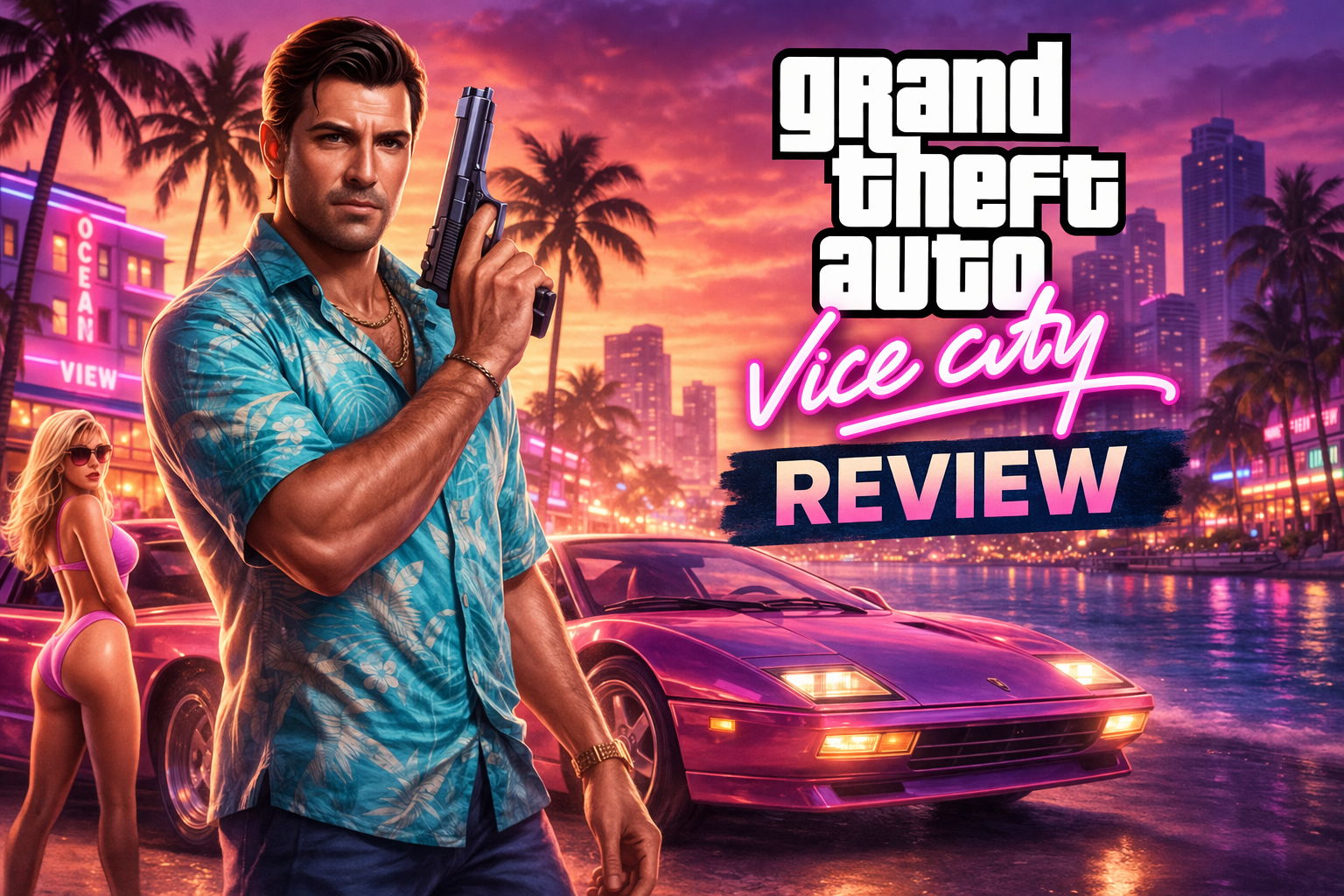
Some games age because technology moves on. Others survive because style becomes stronger than hardware. Grand Theft Auto: Vice City belongs in the second group. Released in 2002 and set in a fictional 1986 Miami-inspired city, Rockstar’s follow-up to GTA III did more than make the map bigger or the action louder. It gave the open-world formula a stronger personality: pastel skylines, palm trees, cocaine-era crime drama, radio stations packed with era-defining music, and a story built around ambition, betrayal, and power. Rockstar itself still presents the game as a rise-to-the-top criminal story wrapped in the excess of the 1980s, and that framing remains the key to why Vice City is remembered so fondly.
At launch, critics treated Vice City as more than a routine sequel. GameSpot praised it as a follow-up that delivered nearly everything players could want after GTA III, arguing that it was bigger, better, and richer in content. Metacritic’s aggregation shows just how strong that reception was: the PlayStation 2 version sits at 95/100, indicating universal acclaim. PC Gamer’s original 2003 PC review was also highly positive, scoring it 93% and praising how smoothly it ran on capable machines while noting that mouse support lifted shooting and precision on PC. Put together, those reactions tell a clear story: Vice City was not simply successful because it repeated GTA III’s formula. It succeeded because it refined it into something more cinematic and more memorable.
What still stands out first is the atmosphere. This is the area where review consensus and player memory overlap most strongly. Critics repeatedly highlighted the game’s sound, music, and open-world design, while players still talk about how the game “feels” rather than only what it lets them do. That distinction matters. Vice City is not just a sandbox full of missions; it is a mood machine. The city glows with artificial luxury and hidden menace. The beaches, neon hotel strips, seedy backstreets, and coastal roads are all exaggerated enough to feel iconic without losing their sense of place. Even decades later, discussions of the game often return to the same point: the map may be smaller than newer GTA worlds, but it has a stronger identity than many larger open worlds.
The soundtrack and radio design are a huge part of that identity. Reviewers praised the music on release, and that praise has only grown with time. Vice City’s radio stations do not feel like background decoration; they shape the entire emotional texture of the game. Cruising through Ocean Beach with the radio on turns simple travel into performance. Later reflections from PC Gamer also emphasized how central Rockstar’s curated radio-station design was to the 3D GTA games, noting that the stations were carefully assembled around genre, hosts, and fake ads rather than acting like a random playlist. That design choice is a major reason Vice City still feels alive. It does not merely depict the 1980s; it performs them.
Then there is the story, which remains one of Vice City’s most accessible strengths. Tommy Vercetti’s climb from recently released enforcer to criminal kingpin gives the game a direct, propulsive arc. Compared with some later Rockstar stories, Vice City is not especially subtle, but it is effective because it understands its own tone. It borrows openly from crime films and television associated with the era, especially the kind of glossy, violent rise-and-fall fiction that defined 1980s pop culture. That sense of pastiche is part of its charm. The game knows exactly what fantasy it is selling, and it commits to it completely.
Where the experience becomes more mixed is in the moment-to-moment gameplay, especially by modern standards. This is the area where both critics and players tend to become more cautious. Contemporary reviews were enthusiastic overall, but even older summaries of the game’s reception note criticism around controls and technical issues. Modern retrospectives and player comments are even more direct: the combat can feel clunky, mission structure can be punishing, and the lack of checkpoints makes failure more frustrating than many current players will tolerate. Kotaku’s ranking-style retrospective singled out Vice City’s combat as one of its weak points, arguing that its dated gunplay stands out more because the rest of the package is so attractive. Player reviews on Metacritic echo similar complaints, often saying the controls are not smooth by modern standards and that some missions are tedious even when the overall game remains beloved.
That criticism is fair. Vice City often feels best when you are in the world, not necessarily when you are wrestling with its toughest missions. Driving, exploring, listening to the radio, buying properties, and absorbing the city’s atmosphere can be more satisfying than a badly aged firefight. This is why the game still earns affection despite obvious friction. Players forgive Vice City because its strongest pleasures are not limited to mechanical polish. It excels at fantasy, rhythm, and place. It makes you want to inhabit its version of 1986 even when individual systems show their age.
The PC version improved part of that experience. PC Gamer’s original review emphasized how mouse aiming changed the feel of play, making precise shooting far more enjoyable. Broader reception summaries also note that reviewers generally preferred the PC version’s control improvements, especially targeting with mouse and keyboard, even if visual upgrades were less transformative than players might expect. In other words, Vice City on PC helped solve one of the game’s most persistent weaknesses, though it did not erase all of them.
Its legacy is difficult to overstate. Vice City was one of the defining hits of its era, and summaries of its commercial performance describe it as the best-selling game of 2002 and one of the PlayStation 2’s biggest successes. More important than raw sales, though, is its influence on how players think about open worlds. GTA III proved that a 3D urban sandbox could work. Vice City proved that the same structure could also have a sharply authored vibe, a stronger soundtrack identity, and a more seductive sense of fantasy. That is why so many discussions of the series still treat Vice City as a peak or near-peak entry. Even people who prefer San Andreas or later GTA games often admit that Vice City has a unique atmosphere no sequel fully replaced.
So, is Grand Theft Auto: Vice City still worth playing today? Yes, but with the right expectations. If you want modern mission design, forgiving checkpoints, smooth gunplay, and contemporary movement, you will feel its age quickly. But if you value atmosphere, soundtrack, city design, and a tightly focused crime fantasy, Vice City still delivers something many bigger games struggle to achieve: a world with a personality so strong that simply existing inside it feels entertaining. That is the secret behind its staying power. Vice City is not timeless because every mechanic still shines. It is timeless because its style, confidence, and sense of place remain hard to imitate.
Verdict:
Grand Theft Auto: Vice City remains one of Rockstar’s most stylish and emotionally memorable games — flawed in control and mission design, but still outstanding in atmosphere, music, and world-building.