
The rise in the UK state pension age is often described in tidy official language. It is framed as sustainability, demographic change, long-term planning, fairness between generations. All of that is real, to a point. But it also softens what the policy actually does. When the state pension age rises, the cost of retirement does not disappear. It moves. Some of it stays with government, which saves money by paying the pension later. Some of it lands on people in their mid-60s, who may have to work longer, use savings earlier, lean more heavily on a partner, or go without the income they assumed would arrive at a certain point. That is the harder truth inside the cleaner phrase.
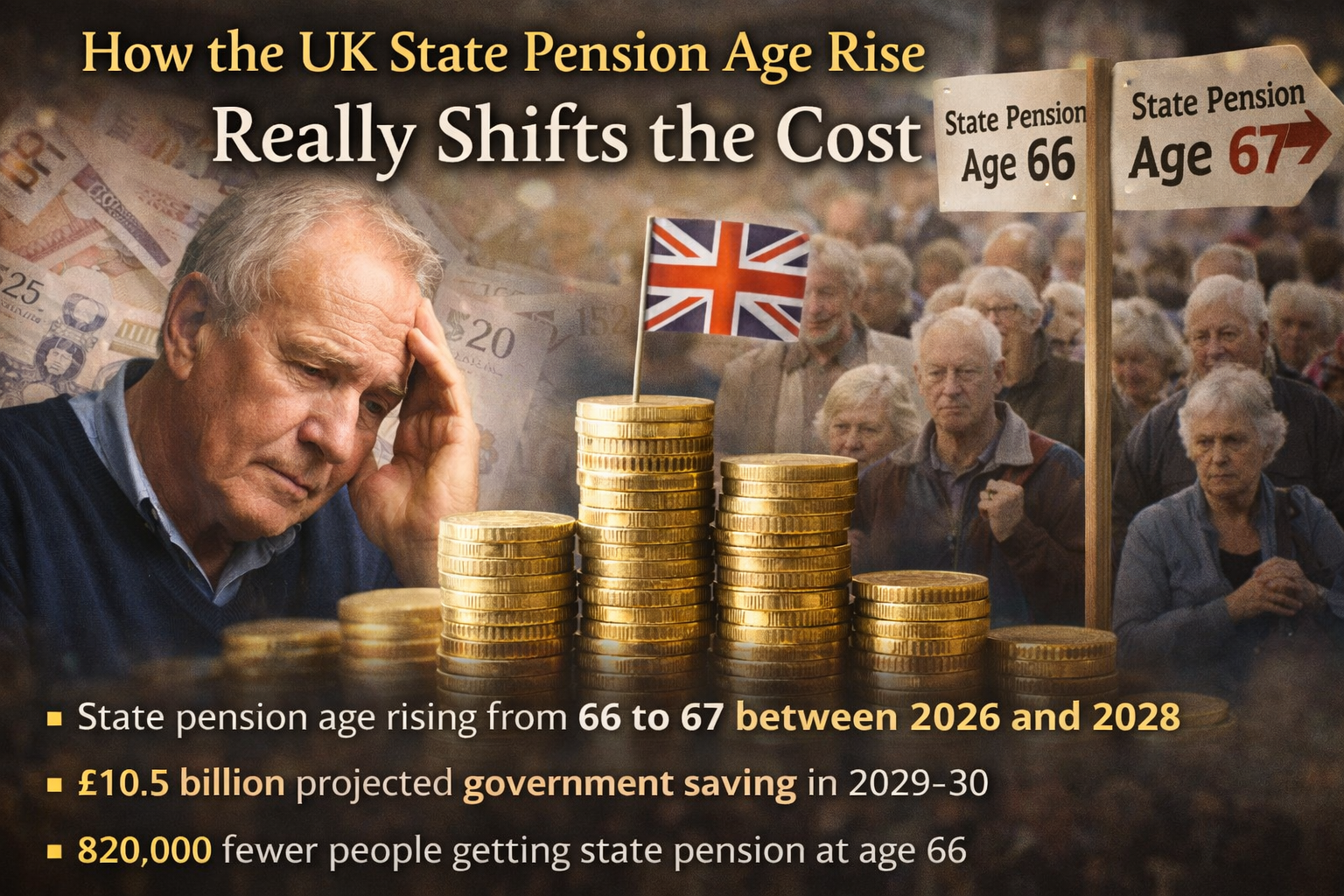
That is why this is not just a pensions story. It is a public-finance story, a labour-market story, and a fairness story. The government confirmed in 2023 that the rise to age 67 would go ahead as planned, and the current timetable means the state pension age is now rising from 66 to 67 between April 2026 and March 2028. The House of Commons Library says the later rise to 68 is still legislated for 2044 to 2046, though it remains under review. So this is not a distant theory any more. The change is already under way.
What is changing now
The immediate reform is clear enough in law. The state pension age for men and women is moving from 66 to 67. The Institute for Fiscal Studies says that from the start of April 2026 the age begins rising, reaching 67 in early 2028. Age UK also notes that people born from April 1961 to March 1977 will generally reach state pension age at 67, while those born between April 1960 and March 1961 are in the transition window where the age rises gradually.
The government’s case is built around sustainability. In its review, it said the state pension must remain fair and affordable as life expectancy has risen over the long run and the population has aged. The Government Actuary’s Department bulletin backing the 2023 review also repeated that the rise to 67 would proceed as legislated and that future changes would continue to be reviewed. In plain English, ministers are saying the country cannot simply keep extending years in retirement without adjusting the age at which the state begins paying.
That argument has a real logic behind it. The Office for Budget Responsibility’s long-term fiscal work shows state pension spending has risen from around 2 per cent of GDP in the mid-20th century to around 5 per cent today, and in its central projection it climbs to 7.7 per cent of GDP by the early 2070s. That does not automatically mean every rise in pension age is fair or well designed, but it does explain why governments keep returning to the issue. The numbers are not small.
Why the Treasury likes this policy
From the Treasury’s perspective, increasing the state pension age is one of the cleanest ways to reduce future spending. The OBR says the move from 66 to 67 has a significant fiscal impact and is expected to reduce borrowing by £10.5 billion in 2029–30 compared with keeping the age at 66. The largest saving comes from fewer people being eligible for the state pension in that year. The OBR estimates that about 820,000 fewer 66-year-olds will be receiving the state pension in 2029–30 than would have been the case without the rise.
There are smaller knock-on savings too. The same OBR analysis says there are additional reductions in spending because fewer 66-year-olds qualify for Pension Credit and Winter Fuel Payment. Taken together, the policy produces a big budget saving not because retirement has somehow become cheaper, but because the state delays when it starts paying. That distinction matters. It is the centre of the whole debate.
There is also a broader political attraction here. Governments can defend a pension-age rise as responsible, fiscally serious, and shaped by demographics rather than ideology. That makes it easier to present than many direct cuts. But for the people affected, the experience can feel a lot like a cut anyway. When expected pension income arrives later than you planned for, the labels matter less than the gap in the budget. That is where policy language and lived experience start to separate.
Where the cost actually goes
If government saves money, someone else usually absorbs the pressure. In this case, much of the cost is shifted onto people approaching retirement. The IFS says the main direct effect of the rise is a delay in receiving state pension income, which lowers disposable income for many affected people. That may sound obvious, but it is important. Public-finance gains are not abstract here. They come from households waiting longer for money that would otherwise have reached them sooner.
For some people, the answer is to work longer. That is the neat version policymakers often have in mind. But the evidence is more mixed. The IFS says earlier rises in the state pension age increased employment for some, especially those already attached to the labour market, but many did not simply move into work to make up the loss. The effect is uneven. Some can carry on. Some cannot. Health, job type, caring duties, redundancy, age discrimination, and regional labour-market weakness all shape what “work longer” really means in practice.
This is where the policy starts to look less like an administrative adjustment and more like a transfer of risk. A professional in relatively good health with savings and some flexibility at work may be able to absorb a later pension age without being knocked too hard. A warehouse worker, cleaner, carer, driver, or someone with a body already worn down by decades of physical labour may experience that extra wait very differently. The legal rule is the same. The practical burden is not.
The people most likely to feel the squeeze
The state pension age rise does not hit everyone equally. Some groups are more exposed than others.
- People in poor health may struggle to stay in work to the new pension age. Age UK has argued that healthy life expectancy matters as much as overall life expectancy because the real question is not only how long people live, but how long they can work safely and realistically.
- Workers in physically demanding jobs often face a harsher gap between official pension age and actual working capacity. Research cited in Age UK’s consultation responses suggests that future rises can be especially hard on people in lower-income or more physically draining occupations.
- People with weak private provision are more reliant on the state pension and have less room to bridge the delay with savings or private income. GOV.UK’s own state pension pages emphasise that entitlement depends on National Insurance records, and many people do not receive the full amount.
- Those already out of work in their mid-60s may be among the most vulnerable, because a later pension age does not automatically create employment opportunities. The IFS notes that previous rises did not simply pull everyone into work; many remained outside employment and had to manage with lower incomes.
This is why averages can mislead. On paper, a pension-age rise may look rational and manageable. In households already close to the edge, it can feel like one more policy that assumes flexibility where there is very little.
The awkward contrast: pensions are rising, but access is moving later
There is another layer to this story that can confuse people. The pension itself has just increased. Government announced that more than 12 million pensioners would see their state pension rise by up to £575 a year, with the full rate of the new state pension rising by 4.8%, from £230.25 to £241.30 a week, and the full basic state pension rising from £176.45 to £184.90 a week. Those new rates are set out in the 2026–27 benefit and pension rates.
So two truths are now sitting side by side. Current pensioners are receiving a higher weekly payment, while future pensioners affected by the age rise must wait longer to start receiving theirs. Politically, that is a strange balance. It lets government say it is protecting pensioner incomes through the triple lock while also improving the fiscal position by delaying access for those just below pension age. Both statements are true. They just apply to different people.
That split matters because it changes the emotional shape of the debate. It is not simply “government is being stingy” or “government is being generous.” It is more selective than that. Pensioners already over the line see a rise. Some of those approaching the line find the line moving. That does not make the policy incoherent, but it does make it feel uneven from a household point of view.
The fairness argument, and why it never quite settles the issue
Supporters of a higher pension age tend to lean on fairness between generations. The idea is simple: if people live longer, it may not be reasonable for the state to fund ever longer retirements without adjustment. Younger workers also pay for today’s pension system, so a later pension age can be framed as part of keeping the contract sustainable rather than letting the burden drift upwards indefinitely. That is broadly the government’s argument, and it has some force.
But fairness can be measured in different ways. One version asks whether the system is affordable over time. Another asks whether people in different jobs, places, and health conditions can realistically bear the same pension age. If healthy life expectancy is uneven, then a uniform pension age can produce very unequal outcomes. A person who lives longer and can work in comfort into their late 60s may experience the policy as a mild adjustment. Someone with chronic health issues or a lifetime of hard physical work may experience it as a substantial loss.
That is why this issue never stays resolved for long. The fiscal case is strong enough to keep the reform alive. The social reality is messy enough to keep the argument open. Neither side fully cancels the other out.
What people near retirement should actually watch
For readers close to retirement age, the debate is not only philosophical. It is practical. A few points matter more than the rhetoric.
- Check your exact state pension age, because transition windows can catch people out. Age UK and GOV.UK both point people to the official checker rather than assumptions based on round ages.
- Get a state pension forecast, because not everyone qualifies for the full amount. GOV.UK says your payment depends on your National Insurance record.
- Do not assume the pension starts automatically. Age UK notes that you generally need to claim it, and people should receive a letter from the Pension Service before they reach state pension age.
- Think about the bridge period if you are in the affected age band: savings, part-time work, private pension timing, partner income, housing costs, and debt all matter more when the state pension starts later. This is an inference from the income delay identified by the IFS and OBR, not a line those sources phrase exactly this way. It follows from the fact that later eligibility means a longer period to finance before the pension arrives.
- Watch future reviews, because the age 68 timetable remains politically live. The 2023 review left the 2044–46 law in place for now, but government said it would revisit the issue within two years of the next Parliament.
Why trust in the system still matters
The state pension age debate is not only about money. It is also about predictability. Major life planning depends on people knowing when support will arrive. That is one reason communication around pension-age changes has caused so much political heat in the UK. The House of Commons Library notes the continuing controversy over how state pension age increases were communicated to many women born in the 1950s, a dispute that has shaped public trust in later pension-age changes as well.
That history matters because even a policy with a defensible fiscal rationale can become corrosive if people believe the rules move too fast, too late, or without enough warning. The Government Actuary’s Department bulletin said the government remains committed to the principle of giving 10 years’ notice of state pension age changes. That principle is not a small technicality. It is central to whether people feel they can plan around the system at all.
In a sense, pension policy depends on credibility as much as arithmetic. Households make decisions years in advance: when to stop work, when to draw private pensions, whether to downsize, whether to support adult children or elderly parents. A later state pension age can be survivable if people see it coming clearly enough. It becomes much more painful when it collides with weak savings, ill health, and uncertain communication.
The honest bottom line
So what does the state pension age rise really cost?
From the government’s side, it saves money. That is not speculation. The OBR says it cuts borrowing materially, largely because the state pays the pension to fewer people at age 66 than it otherwise would. From a fiscal point of view, that is the whole point.
From a household point of view, though, the saving is financed partly by delay and pressure. Some people will work longer and manage reasonably well. Some will use savings or private pensions to bridge the gap. Some will absorb the hit through lower disposable income. Others, especially those in poor health or insecure work, may feel the reform as a serious strain rather than a neat adjustment. The IFS and Age UK material both point toward that unevenness, even if they describe different parts of it.
That is why the cleanest way to describe the reform is not that it removes the cost of retirement. It redistributes it. The public finances improve. Some of the pressure shifts onto older workers and near-retirees. That may still be a policy governments choose. But it should be described honestly. Not as a frictionless modernisation. Not as a painless fix. More as a trade-off: one that may make the state pension system more affordable on paper, while asking a particular slice of the population to carry more uncertainty before retirement fully begins.
Key takeaways
- The UK state pension age is rising from 66 to 67 between April 2026 and March 2028.
- The OBR estimates this will reduce borrowing by £10.5 billion in 2029–30.
- Much of the saving comes from about 820,000 fewer 66-year-olds receiving the state pension in that year.
- The full new State Pension for 2026–27 is £241.30 a week, after a 4.8% increase.
- The financial burden of a later pension age is not shared evenly; people in poor health, insecure work, or with little private provision may be hit harder.
- The state saves money, but many households face a longer gap to fund before pension income begins.
References
GOV.UK – State Pension Age Review Published
House of Commons Library – State Pension Age Increases
Office for Budget Responsibility – The Fiscal Impact of Increases in the State Pension Age
Institute for Fiscal Studies – State Pension Age 67 Is Coming: What to Watch as It Rolls Out