A queue that barely moved, a plane that left nearly empty, and a family forced into a £1,600 reroute — the EU’s new Entry/Exit System turned a routine short-haul trip into a very public lesson in how digital policy can fail at the last mile.
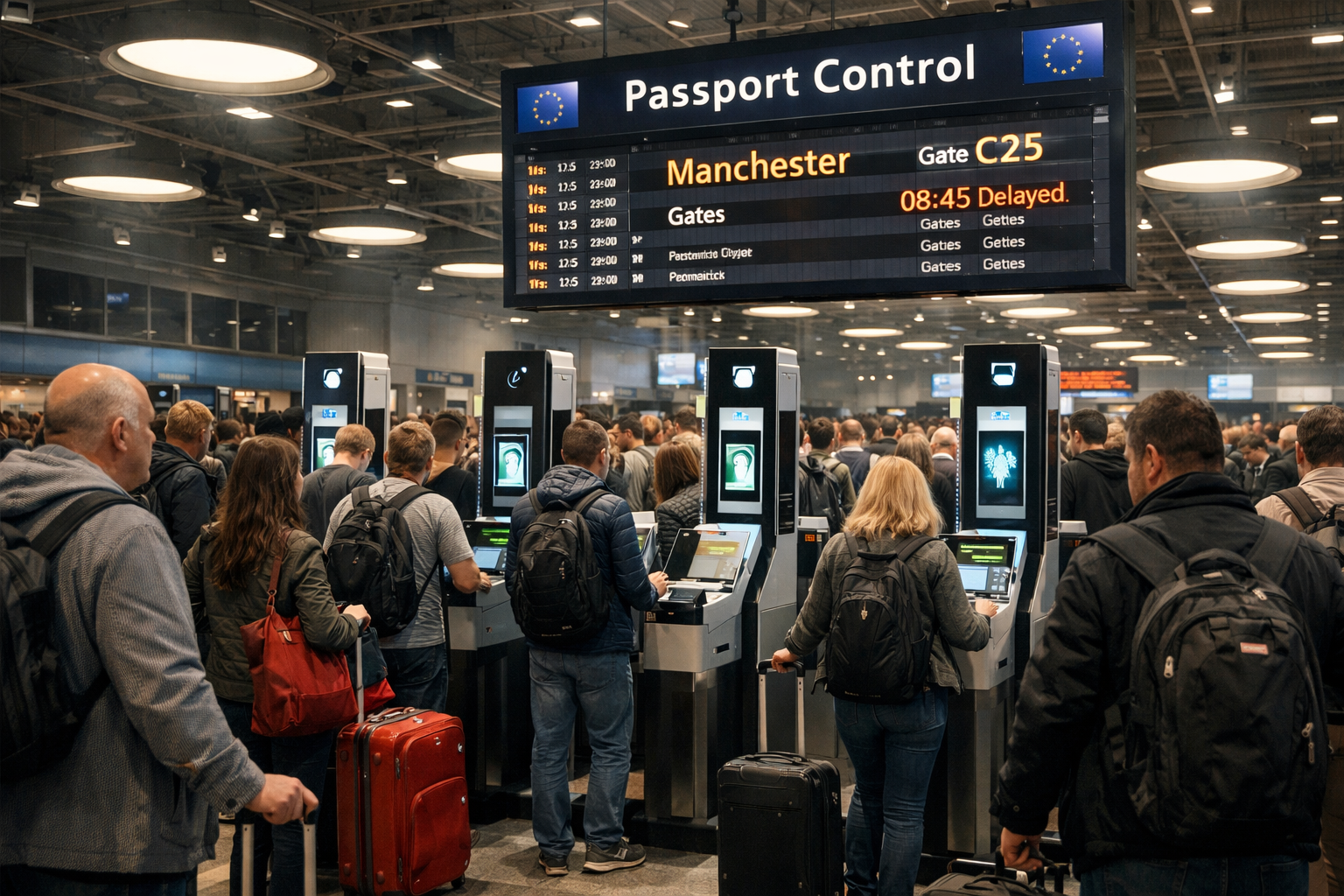
For a few ugly hours on Sunday morning, Milan Linate delivered the kind of travel image that stays with people. A gate-bound aircraft. A queue that barely moved. British passengers stuck in a border-control funnel that looked modern on paper and chaotic in practice. For the people trapped on the wrong side of it, the experience was brutally simple: their Manchester flight was still theirs on the screen, but not in reality.
The best-documented account so far comes from the Hume family, whose experience was reported by The Independent. They say they arrived at the airport almost three hours before departure, followed the airline process, and still failed to get through in time. According to the same reporting, only 34 of the 156 booked passengers boarded easyJet flight U2-5420 from Milan Linate to Manchester, leaving 122 behind. The family later spent more than £1,600 to get home via Luxembourg after being told they had been marked as no-shows.
What stands out is not simply that a queue formed. It is that a system designed to modernise border control created a scene that looked older, slower, and far less humane than the one it was supposed to replace.
The EU’s new Entry/Exit System, or EES, is meant to replace manual passport stamping with digital records and biometric checks for non-EU short-stay travellers. In theory, it is a cleaner and smarter system. On the ground at Linate, though, passengers described a bottleneck marked by long waits, visible confusion, and processing that did not appear to match the volume of people trying to pass through.
The Technical Core: What the EES Is, and Why It Struggled So Fast
According to the European Commission, the EES became fully operational on 10 April 2026, after a progressive rollout that began in October 2025. It replaces passport stamps with digital entry and exit records for eligible non-EU nationals and records facial images, fingerprints and travel-document data. The Commission said on launch day that the system had already registered more than 52 million entries and exits during rollout.
That sounds like scale. It does not automatically mean readiness at every pressure point.
A joint statement from ACI EUROPE said passenger waiting times at some airport border controls were already reaching two to three hours at peak periods once the system became fully operational.
Earlier, IATA had warned of excessive waits linked to understaffing, unresolved technology issues and weak border automation uptake.
Why queues like this get worse very quickly
- First-time biometric registration adds time to each individual transaction.
- Small delays per passenger grow into large queues once a departure bank starts stacking up.
- If equipment is available but not fully utilised, the queue stops being a nuisance and starts becoming an operational failure.
- When several UK-bound or non-EU passenger flows depend on the same control point, the system can jam suddenly rather than gradually.
That last point matters. Border systems do not fail only when the software fails. They fail when policy, staffing, hardware, lane management and passenger flow are all technically “live” but not actually working together. Milan looks less like a freak incident than an early warning about that gap.
The Airline Problem: Why the Flight Did Not Keep Waiting
There is an uncomfortable split inside stories like this. Passengers experience it as abandonment. Airlines experience it as a hard operational wall. Those two views collide badly, and they usually collide at the gate.
ITV News reported that easyJet held the flight for nearly an hour before departure, but ultimately said it had to leave because the crew were reaching their safety-regulated operating hours. The airline also said the disruption was outside its control and that affected passengers had been offered a free transfer to another flight.
For the stranded passengers, the language of operations barely matters. What they remember is that the aircraft left and they did not.
That is the reputational problem. Consumers do not divide an airport journey into neat boxes labelled airline, border police, airport authority and government system. They see one connected process. When the chain breaks, the carrier name on the booking tends to absorb the public anger, even if the bottleneck started upstream.
That does not remove the airline from scrutiny. It simply means the real failure here sits across several institutions at once. A digital border project can be officially live, legally compliant and still produce a passenger experience that feels indefensible.
Passenger Rights: What Affected Travellers May Be Able to Claim
This is where the language needs care. Passengers on this route may have rights under Regulation (EC) 261/2004, but the outcome can depend on how the event is classified and whether the airline argues that the disruption was caused by extraordinary circumstances outside its control.
Official Your Europe guidance says denied boarding compensation starts at €250 for flights of 1,500 km or less, while airlines also owe duties of care such as meals, accommodation where relevant, and rerouting or reimbursement in qualifying cases. The same guidance also makes clear that compensation rules can change where extraordinary circumstances apply.
Practical steps for stranded passengers
Save evidence immediately. Keep boarding passes, screenshots, receipts, timestamps, and any messages from the airline.
Ask the airline for its position in writing. Was the event treated as missed departure, denied boarding, disruption, or something else?
Claim rerouting, reimbursement and duty of care where appropriate. If you had to pay out of pocket for food, hotels or replacement travel, keep every receipt.
Submit the airline complaint first. ENAC says passengers should begin with the carrier that issued the ticket.
Escalate to ENAC if needed. The Italian regulator says passengers may complain to ENAC if the airline does not reply within six weeks or the reply is unsatisfactory.
That last part is important. ENAC is the national enforcement body for these rights in Italy when the disruption occurs on a departure from an Italian airport. So while the legal outcome may not be automatic, the route for complaint is not vague.
This section is general information, not legal advice.
Final Verdict: A Border Future That Arrived Before the Ground Operation Was Ready
The deeper lesson from U2-5420 is not that biometrics are doomed or that digital borders cannot work. It is that border modernisation becomes fragile the moment policymakers confuse a working framework with a working journey.
The EES has a real policy purpose. The European Commission says it is designed to modernise border management, improve security and digitally track entries and exits more effectively. None of that is trivial. But strategy does not move a queue. Execution does.
Milan was not just an airline mishap. It was an early public stress test for a major digital border rollout. The system may still deliver its long-term goals, but this incident showed how quickly the promise of efficiency can collapse when staffing, equipment use, passenger flow and operational judgment fail to line up. Travellers do not measure success in policy milestones. They measure it by whether the plane leaves with them on it.
Sources
- ITV News — More than 100 easyJet passengers miss flight to Manchester after new EU border control checks
- The Independent — More than 100 easyJet passengers stranded in Italy after European border system chaos
- European Commission — Entry/Exit System is fully operational
- Travel to Europe — Entry/Exit System overview
- ACI EUROPE — EES disruptions on first day of full operations
- IATA — Airports and airlines call for immediate Schengen Entry/Exit System flexibility
- ENAC — Passenger rights in case of denied boarding, cancellation or long delay
- Your Europe — Air passenger rights