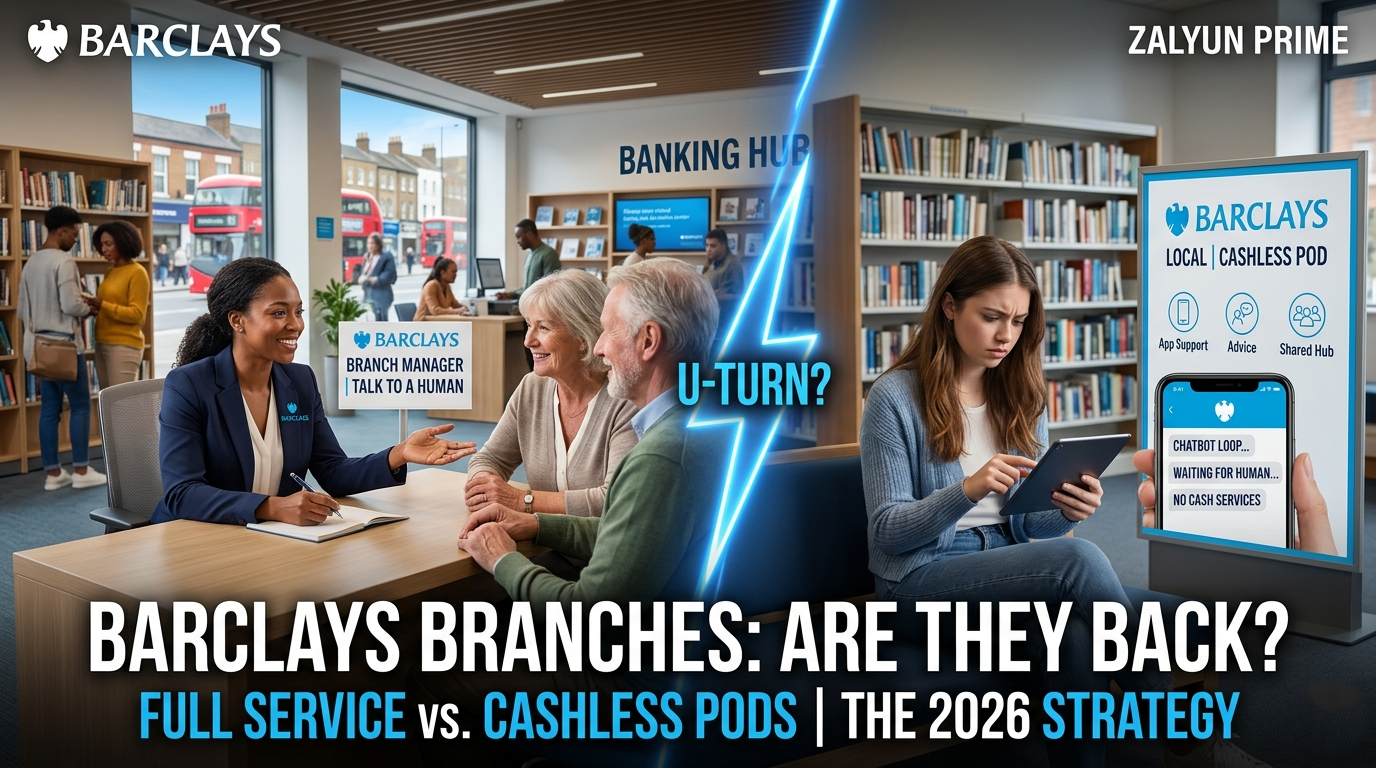
After a decade defined by rapid branch closures, Barclays appears to be rebalancing part of its high-street strategy. Recent reporting in April 2026 says Barclays UK chief executive Vim Maru wants to expand the bank’s physical presence beyond its current branch estate and bring back the more traditional role of the bank manager. The shift does not mean a retreat from digital banking. It looks more like an attempt to pair mobile convenience with more visible in-person support for customers dealing with bigger financial decisions.
That matters because the earlier strategy left Barclays with a much smaller traditional footprint. Reported branch numbers vary by time and source, but current coverage places the full-service network at around 206 branches. In practical terms, that means the question is no longer whether digital banking dominates. It does. The question is whether customers still want a human point of contact for higher-stakes moments such as mortgages, fraud issues, bereavement, or complex account problems.
Attribution note: The bank-manager revival and branch-expansion angle in this article is based on current reporting and should be read as a reported strategic shift rather than a fully detailed formal policy announcement from Barclays.
Why the “Bank Manager” is Coming Back
According to reporting by Business Live and The Times, Maru’s case is straightforward: customers may be happy to use apps for everyday transactions, but many still want face-to-face help when a decision is complicated, urgent, or emotionally loaded. In that context, the return of the “bank manager” title is not just nostalgic branding. It signals a move away from a purely generalist service model and back toward identifiable in-branch authority.
The Regulatory Guardrails: FCA Access to Cash Rules
This strategy is not unfolding in a vacuum. On 18 September 2024, the Financial Conduct Authority brought new access-to-cash rules into force. The regime requires designated banks and building societies to assess local gaps in cash access and help address significant ones before cash services disappear.
For Barclays, that means its broader location mix matters. The bank’s Barclays Local sites and its participation in shared Banking Hubs are not just convenience add-ons. They are part of a wider service model shaped by customer demand, branch economics, and the regulatory expectation that access to essential banking and cash services should not simply vanish from a community.
Strategic Navigator: Where to Access Barclays Services
Barclays now operates through several distinct service formats. Knowing the difference makes a visit more useful.
| Service Type | Best For… | Key Limitation |
|---|---|---|
| Traditional Branch | Complex advice, full counter services, and higher-stakes conversations where face-to-face support matters most. | The full-service network is much smaller than it once was, so branch access remains uneven by area. |
| Barclays Local | Digital support, account help, money-management guidance, and basic face-to-face assistance in community settings. | Cashless. You cannot deposit or withdraw notes or coins at these sites. |
| Shared Banking Hub | Everyday cash deposits and withdrawals, plus in-person help for routine banking tasks. | Bank staff attend on specific designated days, so service availability varies by provider and location. |
The Impact of Banking Hubs
The quiet structural change on the high street may be the rise of shared banking spaces managed by Cash Access UK. The organisation says it currently has 230 banking hubs and 140 deposit services open across the country. That model matters because it keeps access to cash and basic in-person support alive in places where a standalone branch may no longer be commercially viable.
In other words, the future of high-street banking may not be a return to the old branch network. It may be a mixed system: fewer traditional branches, more local community sites, and a growing layer of shared hubs that preserve the practical side of physical banking.
Authoritative References
- Barclays – Our locations explained
- Barclays – Ways to bank
- FCA – Access to cash
- Cash Access UK – Shared cash and banking services
- The Times – Barclays back on the high street
- Business Live – Barclays planning return of high street bank manager
Editorial disclosure: This article is for informational purposes and does not constitute financial advice. Branch opening hours, in-person services, and staff availability can vary by location, so readers should verify details through the official Barclays website or app before travelling.