
By the Zalyun Prime Editorial Team
Practical Insights for a Fast-Changing World
Introduction
The Weight of the Next Step
For many students and parents in the UK, the hardest part of education is not revision or exams. It is the silence that follows the question: What comes next? Choosing a post-16 or post-18 path can feel like a high-stakes decision, especially when so many families worry that one wrong step could shape the years ahead.
In England, where 16 to 17-year-olds are legally required to remain in education or training, that pressure is especially familiar. The system includes academic routes, technical pathways, work-based training, and higher education. But here is the reality: those routes do not all suit the same kind of learner.
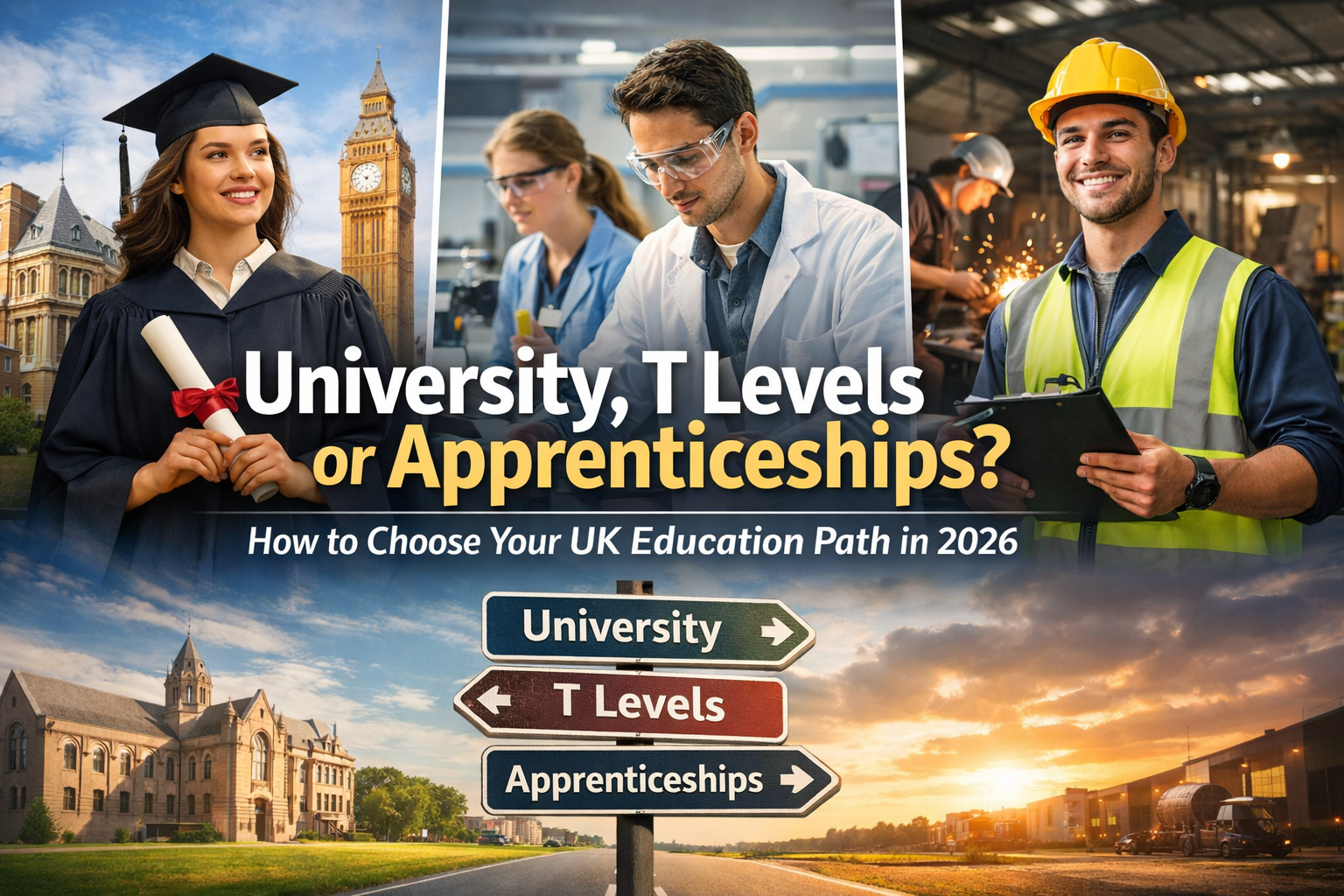
The most useful way to look at education in the UK today is this: the best route is not the most prestigious one, but the route that fits the learner best. While many families still default to university as the only “proper” option, the official picture in 2026 is far more nuanced. Education works better when students choose by learning style, career direction, and financial reality, not by social expectation.
Part 1: Why the “University Is Always Best” Idea No Longer Works
University still matters. It opens doors in medicine, law, and high-level research. The House of Commons Library reported that there were around 765,000 applicants for full-time undergraduate places through UCAS in 2025, and almost 578,000 were accepted. Those are record-high numbers.
At the same time, the pattern is becoming more selective. The higher education entry rate among UK 18-year-olds peaked at 38.2% in 2021 and fell back to 36.3% in 2025.
The Shift to Pragmatism
Students are not rejecting higher education. They are becoming more careful about it. A degree is a powerful tool when it matches a clear goal, but it can feel like a burden when chosen simply because a student feels they “should” go.
One of the biggest mistakes families make is treating education like a prestige ladder instead of a decision framework.
The academic learner: may need the intellectual depth, structure, and progression that university offers.
The practical learner: may be better served by an apprenticeship that offers workplace experience, income, and qualification growth at the same time.
The smarter question is no longer Should they go to university? It is What kind of path gives them the strongest long-term return?
Part 2: What the UK System Actually Offers After Age 16
According to the Department for Education, 92.2% of 16 to 17-year-olds in England were in some form of education and training at the end of 2024. By age 18, that figure dropped to 65.4%. That matters because participation often becomes more fragile as choices widen and financial realities begin to shape decisions more directly.
The Mixed-Route Landscape
Ofqual’s guidance reflects a system that is no longer academic-only. After GCSEs, the main options are broader than many people realise.
A Levels: The Academic Standard
A Levels remain the clearest route for students who enjoy subject depth, essays, exams, and traditional academic progression. They are still one of the most widely recognised pathways into university.
T Levels: The Career-Shaped Option
For students who want a technical field but are not ready to move straight into full-time work, T Levels offer a more career-focused route.
- They are broadly equivalent in size to 3 A Levels
- They usually involve 1,100 to 1,300 classroom hours over two years
- They include an industry placement of at least 315 hours
The difference is practical and important. A Levels are often strongest for general academic progression. T Levels are stronger for students who want a clearer occupational direction while still studying mainly in an education setting.
Part 3: When Apprenticeships Are the Better Plan
Apprenticeships still carry an outdated image in some families, but the current picture is much stronger. In England, apprentices work, get paid, and gain a qualification while training.
The Apprenticeship Advantage
Earn while you learn:
You are an employee from the start, with a contract and a wage.
Built around real work:
The typical model is 80% on the job and 20% off-the-job training.
Open to different stages of life:
You can start at 16, and in some cases even after completing previous qualifications, including a degree.
Students who learn best through applied work should not be pushed into a purely academic route just to satisfy somebody else’s expectations. Ignoring the strength of modern apprenticeships is not ambition. It is poor guidance.
Part 4: Student Finance and the Financial Reality of 2026
Money shapes educational decisions more than many institutions like to admit. In England, the GOV.UK student finance system is already open for the 2026 to 2027 cycle.
The Critical Timeline
A Student Loans Company announcement on 23 March 2026 confirmed that full-time undergraduate students from England whose courses begin between August and December 2026 can now apply. They are encouraged to do so before 15 May 2026.
Key Facts to Remember
- Most students do not have to pay tuition fees upfront
- Extra support may be available for students with children, adult dependants, or disabilities, including long-term health conditions and specific learning difficulties
- Students can apply before they have a confirmed university place and update details later
Student finance should not scare people away from university. But it should not be brushed aside either. A healthy decision is an informed one. Families should understand what support exists, what has to be repaid, and whether the long-term value makes sense for the student involved.
Part 5: The Hidden Issue — Access Is Not the Same as Success
One of the weakest parts of the public education conversation is the obsession with getting in and the lack of attention to staying in.
Official absence data for schools in England shows a 20.0% persistent absence rate, meaning one in five pupils missed 10% or more of their sessions. That figure is lower than the previous year, but still above pre-pandemic levels.
That matters because educational success is not only about whether a route exists. It is about whether a student can remain engaged, supported, and stable enough to benefit from it.
If a student is burned out, uncertain, or financially stretched, the best next step may not be the most impressive-looking one on paper. It may be the one that offers the strongest structure, support, and chance of long-term success. Choosing a route a student can realistically sustain is often a wiser form of ambition than chasing a prestigious name and dropping out six months later.
Conclusion: Which Route Is Best?
There is no honest one-line answer, but there is a reliable framework.
- University is often best for students who need degree-based progression and enjoy academic depth
- T Levels are often best for students who want technical direction without moving straight into full-time employment
- Apprenticeships are often best for students who want to earn, gain workplace experience, and learn by doing
The UK system is strongest when it allows different learners to move forward in different ways. A student who thrives on theory should not be shamed into chasing quick income. A student who thrives in applied settings should not be shamed into chasing a degree they do not want.
Education works better when the route fits the person.
Key Takeaways for Students and Parents
A mixed model, not a university-only system:
The UK no longer looks like a university-only system. A Levels, T Levels, and apprenticeships now sit side by side as serious mainstream routes for different kinds of learners.
Selectivity over prestige:
The university entry rate among UK 18-year-olds stood at 36.3% in 2025, suggesting that many students are weighing fit, value, and long-term direction more carefully.
The financial window is open:
Student finance for 2026/27 is already open in England, and applying before 15 May 2026 can help make sure funding is in place on time.
Stability matters as much as ambition:
Success is not only about getting into a route. It is also about staying engaged. With a 20.0% persistent absence rate in schools in England, choosing a path that matches a student’s mental, financial, and academic reality matters more than ever.
Frequently Asked Questions
Q: Is university still the best option for UK students in 2026?
A: University remains a major and valuable route, but it is not the only serious option. The best choice depends on the student’s goals, strengths, and preferred way of learning.
Q: What is the main difference between a T Level and an apprenticeship?
A: A T Level is mainly classroom-based and includes a substantial industry placement, while an apprenticeship is mainly work-based and combines paid work with training.
Q: Can I apply for an apprenticeship if I already have a degree?
A: Yes. GOV.UK says it is possible in some cases to start an apprenticeship even if you already have previous qualifications, including a degree.
Q: When is the deadline for 2026 student finance in England?
A: Students are encouraged to apply by 15 May 2026 so funding is ready in time for the autumn start of their course.
Verified References
- Department for Education: Participation in education, training and employment (16 to 18)
- GOV.UK: Find an apprenticeship
- GOV.UK: T Level guidance
- House of Commons Library: Higher education student numbers and trends
- Student Loans Company: 2026/27 undergraduate application launch
- National Careers Service: Route planning and skills support
Editorial Transparency Note
Editorial note: This article was developed with AI-assisted research and drafting support, then reviewed, edited, and finalised by the Zalyun Prime editorial team.



One thought on “University, T Levels or Apprenticeships? How to Choose Your UK Education Path in 2026”