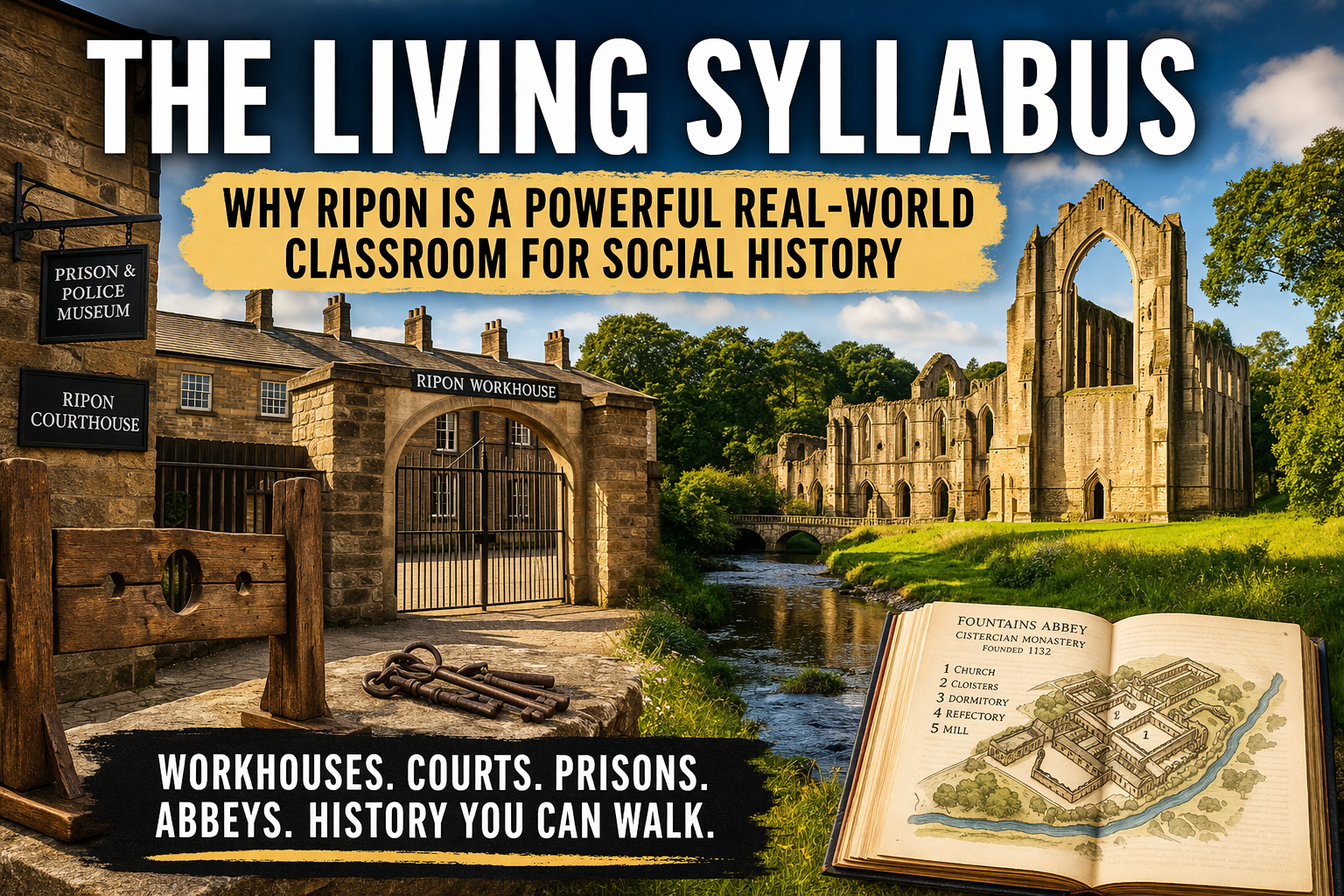
Mention Ripon to anyone south of Yorkshire, and if they know it at all, they will likely conjure up an image of a sleepy, stone-built cathedral city. They might mention the nightly blowing of the horn in the market square at 9:00 PM—a tradition stretching back over a millennium to the “Wakeman.” It is a quaint, picturesque image that sells a lot of postcards. But if you are an educator, a university lecturer, or a student of the social sciences, buying into that chocolate-box veneer is a serious mistake.
When you peel back the tourist layers, Ripon stops being a provincial relic and reveals itself as one of the most striking and revealing real-world learning environments in the United Kingdom. We spend so much time in modern education trying to make history and social policy “engaging” by keeping them in textbooks or digitising them into PowerPoint slides. Ripon does not need that filter. It leaves the harder, unedited realities of British social evolution right there on the pavement. You do not come here simply to look at “nice” old buildings; you come here to understand how the mechanics of our society were actually built, brick by often brutal brick.
1. The Architecture of Poverty: Deconstructing the Workhouse
If you have a cohort of sociology or social policy students grappling with the 1834 Poor Law Amendment Act, reading about it in a seminar room is a dry experience. You can discuss “state intervention” and “welfare deterrents” for hours, but the concept can still remain abstract. However, standing inside the Ripon Workhouse Museum changes the lesson entirely.
The Ripon Museum Trust has achieved something remarkable here: they have not romanticised the space. They have preserved it to clearly explain the cold, Victorian bureaucracy of welfare. Historical experts frequently point out that workhouses were essentially “deterrents in brick.” The architecture itself was designed to ensure that only the truly desperate would seek help.
Source: Ripon Museums – Workhouse History | Ripon Museums – Workhouse Museum
Learning for Students:
- Spatial Control: Students can physically map the hierarchy—the imposing Master’s quarters at the front, designed to intimidate, masking the bleak, segregated dormitories at the rear where families were deliberately split apart.
- The Labour Economy: Examine the original stations for picking oakum or breaking stones. It provides a visceral understanding of the Victorian attitude towards the “undeserving poor.”
- The Policy Legacy: This site can teach an undergraduate more clearly about the historical roots of the UK’s modern welfare debates—and the stigma still attached to state support—than theory alone.
2. The Bureaucracy of Justice: From Public Shame to Private Surveillance
A short walk from the Workhouse takes the curriculum from welfare to criminology. The Courthouse and the Prison & Police Museum complete a grim but fascinating triad of “institutional life.” This is not simply a quirky, interactive day out with plastic handcuffs; it is a chronological map of British penal reform and the evolution of the “State.”
For centuries, Ripon operated under its own jurisdiction—the Liberty of Ripon. This gives law and criminology students a unique lens into how local communities managed law and order long before the modern state centralised everything.
Source: Ripon Museums – Courthouse Museum | Ripon Museums – Ripon Liberty Magistrates
Learning for Students:
- Penal Evolution: You can literally trace the physical transition of justice. It begins with public, physical humiliation—the stocks and the pillory—designed to use the community as the primary enforcer of shame.
- The Rise of the Panopticon: Step into the Victorian cell blocks, and you see a clear stage in the shift toward institutionalised surveillance and the Peelian principles of policing (established by Sir Robert Peel).
- Psychology of Incarceration: The shift from punishing the body in public to punishing the mind in private (solitary confinement and silence) is a profound lesson. Asking a student to stand in one of those cells is an invaluable piece of “learning outside the classroom” that sticks far longer than a YouTube documentary.
3. Fountains Abbey: The Medieval Multinational Corporation
Just a few miles outside the city limits sits Fountains Abbey. While it is a UNESCO World Heritage site and a staple of heritage tourism, for students of economics, business studies, or geography, the “romantic ruin” narrative needs to be flipped.
Fountains Abbey can be understood as the medieval equivalent of a major commercial enterprise. It is the skeletal remains of a massive, highly disciplined, and efficient organisation. Historical economic evidence shows that the Cistercian monks were among the major economic actors of the Middle Ages.
Learning for Students:
- Environmental Engineering: They did not just build a church; they engineered a landscape. Students can trace how the monks manipulated the River Skell to power mills and manage waste on an industrial scale.
- Supply Chain Management: They ran a continent-spanning wool trade from this valley. For a business student, looking at the lay brothers’ quarters—the vast, vaulted undercrofts—is a lesson in early workforce management and mass production.
Source: National Trust – History of Fountains Abbey and Studley Royal | National Trust – Malham Tarn archaeology walk
- Corporate Takeovers: The Dissolution of the Monasteries under Henry VIII was not just a religious shift; it can also be seen as one of the largest state seizures of private wealth in British history, as the state took control of some of the nation’s most profitable assets.
Source: National Trust – History of Fountains Abbey and Studley Royal | The National Archives – The Dissolution of the Monasteries
The Expert “Rx” (Prescription for Field Work)
| Discipline | Field Task | Goal |
|---|---|---|
| Sociology | Map the Workhouse “sight-lines.” | Identify how the Master monitored inmates without being seen. |
| Criminology | Compare the 17th-century stocks to the 19th-century cells. | Define the moment “rehabilitation” replaced “retribution.” |
| Geography | Trace the water diversion at Fountains Abbey. | Understand early human impact on natural topography. |
| Business | Analyse the Abbey’s wool trade output. | Study early examples of corporate monopolies and export taxes. |
Authoritative References for Further Study
- Ripon Museum Trust: A key reference point for the Workhouse, Prison, and Courthouse operational history. (riponmuseums.co.uk)
- National Trust (Fountains Abbey History): Useful for historical and archaeological context on Cistercian life, land use, and monastic economics. (nationaltrust.org.uk)
- North Yorkshire Council Archives: Essential for cross-referencing local “Assize Court” transcripts and Poor Law records.
Final Editorial Thought
We live in a digital culture where education is increasingly screen-based. But society is not a theory; it is a series of physical decisions made by real people, often with lasting consequences for others. Ripon offers something incredibly rare: a concentrated, walkable timeline of how the UK decided to treat its poor, punish its criminals, and build its wealth. It is gritty, it is complex, and for anyone serious about understanding the roots of modern Britain, it is a valuable syllabus.
For students and families thinking about where practical learning fits into a wider academic journey, it also connects naturally with bigger questions around progression, pathways, and how people choose between university, T Levels, or apprenticeships.
Disclosure: To support historical accuracy and verify dates, AI was used to assist in the initial research and structural drafting of this piece. However, the editorial perspective, the “learning outside the classroom” framework, and the final human-led review were conducted by the Zalyun Prime team to ensure the article remains grounded in a British educational context.