
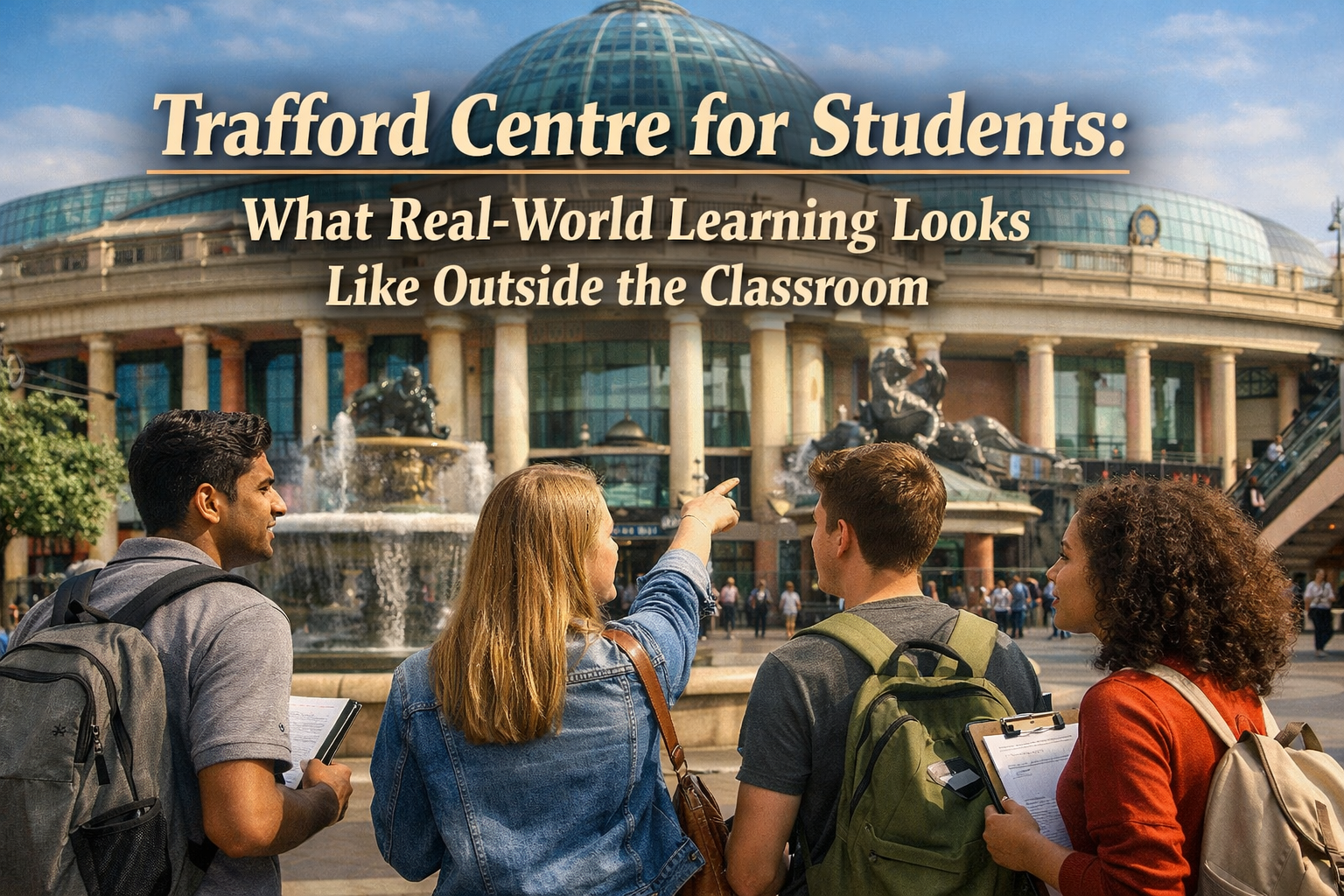
Most people would not instinctively file Trafford Centre under education. They would put it under shopping, leisure, maybe weekend excess. That is exactly why it makes a stronger case study than a more obviously educational venue. Students do not only need curated learning spaces. They need places where systems, design, work, access and behaviour are happening all at once, in public, without the edges sanded down. Trafford Centre offers that in a way a classroom cannot.
The Council for Learning Outside the Classroom makes the broader point clearly: high-quality learning beyond the classroom can open students’ eyes to the world around them, enhance attainment and personal development, and support wellbeing. That matters here, because the value of Trafford Centre is not that it pretends to be a school. It does not. Its value is that it gives students a live working environment to observe, question and interpret.
It becomes educational when you stop looking at it as retail
A weak article would ask where to eat, what to buy, or whether the centre is worth a Saturday visit. None of that belongs in an education category. The stronger question is different: what can students learn from a place like this that they would struggle to grasp from worksheets alone?
Trafford Centre’s own visitor information now explicitly welcomes educational groups. It offers coach access, free parking for up to 27 coaches, and bespoke weekday term-time tours for education groups. Those tours are not framed around shopping tips. They cover the centre’s marble architecture, history, sustainability, staffing and operations. That is the real story. The centre itself is presenting the site as something that can be studied, not merely consumed.
That opens the door to a more useful kind of article for Zalyun Prime. Not “Trafford Centre is fun”. More “Trafford Centre helps explain how modern public-commercial spaces actually work”. That is a better educational fit, and frankly a more interesting one.
Employability looks less abstract here
Students hear the word employability so often that it can lose all meaning. It ends up sounding like one of those education-policy words everyone repeats and nobody pictures properly. Trafford Centre makes it easier to picture.
Trafford College’s Skills Shop is based at the centre and runs a Retail Academy for adult learners who want to build employability and customer service skills for retail. The course covers selling techniques, stock control, retail law and legislation, employability skills and customer service. Trafford College also says learners receive CV and cover-letter support, mock interviews, a work placement opportunity, and a guaranteed interview with on-site employers on completion. The same page says Skills Shop was established in 2013 to bridge the gap between employers and unemployed people looking for work at Trafford Centre, and that it has moved over 500 unemployed people into employment.
That is not a theoretical pathway. It is visible labour-market infrastructure. Students can see, in one place, how training, recruitment and commercial demand join up. For learners interested in business, retail, hospitality or customer-facing work, that is much more concrete than a vague assembly talk about future careers.
Business studies is sitting there in plain sight
Trafford Centre works particularly well as a business studies case study because it gathers multiple versions of consumer-facing business into one environment. The official site describes a destination with over 200 stores, restaurants and bars, while Visit Manchester describes it as having over 200 stores spread across three miles of granite and marble boulevards. Scale matters here. Once a place is that large, students are no longer just looking at individual brands. They are looking at systems: footfall, zoning, visual hierarchy, layout, atmosphere, wayfinding, premium positioning, family appeal and dwell time.
You can learn quite a lot simply by standing still for ten minutes in a busy commercial environment and asking a few unfashionable questions. Why are some brands placed where they are? Why does one corridor feel calmer than another? Why are leisure, food and retail clustered in certain ways? Why does the building keep giving people reasons not to leave? Those are not cynical questions. They are the beginning of understanding how modern consumer environments are designed.
Architecture is part of the lesson, not decoration around it
One of the easier mistakes is to treat Trafford Centre’s design as just a theatrical backdrop. It is more useful than that. The centre’s own education-group offer says visiting groups can receive information about its marble architecture, history and operations. Visit Manchester, meanwhile, highlights the three miles of granite and marble boulevards. That gives teachers and students a practical route into discussing architecture, aesthetic choices, public space design and the relationship between style and behaviour.
A student interested in design can ask how grandeur affects mood. A student interested in media can look at how spectacle functions as branding. A student interested in social observation can notice how people behave differently in a place designed to feel polished, expansive and slightly aspirational. None of this requires romanticising the building. In some ways, its excess is the point. It is easier to analyse a place when it is willing to show its intentions.
Accessibility is not a side issue
Education content often talks about inclusion in very general language, then forgets to show what it looks like in a real public setting. Trafford Centre gives a more practical example.
Its visitor information states that the centre offers mobility scooters through guest services, wheelchair access and facilities as part of its bespoke group-tour offer, a Multi Faith Room, and a weekly Quiet Hour every Wednesday from 10am to 11am, with stores and restaurants asked to reduce music and bright lighting where possible to support a more autism-friendly experience. The Trafford Centre tram stop page from TfGM also points users to accessibility information and facilities for the stop itself.
For students in health and social care, education, public services or design, that is useful material. Accessibility stops being a slogan and becomes a series of operational choices. What changes are made? When are they made? Who are they meant to support? What still depends on staff judgement rather than infrastructure? Those are better educational questions than the usual surface-level praise.
Transport and planning matter more than people admit
There is also a simple reason Trafford Centre works as a learning visit: it is actually reachable. The official visitor page says the centre is about five miles west of Manchester city centre and accessible by Metrolink, bus, nearby train connections, walking and cycling, alongside on-site parking. TfGM says Trafford Centre is on the Trafford Park line, with trams running direct from Deansgate-Castlefield every 12 minutes. That sort of transport reliability matters for education groups because a good visit begins long before anyone arrives.
This sounds dull, but dull logistics are often what separate workable education trips from ideas that stay trapped in planning documents. If staff can get students there without heroic effort, the site becomes usable. That alone pushes Trafford Centre out of the “interesting in theory” category.
Observation is the real skill being trained
What students gain from a place like Trafford Centre is not just information. It is a way of looking. They can practise noticing how spaces guide behaviour, how customer service is performed, how branding differs by audience, how commercial settings handle accessibility, and how work is distributed across visible and invisible roles.
That matters because some learners understand the world better once they can see it functioning. The Council for Learning Outside the Classroom argues that experiences beyond the classroom can help students become more well-rounded citizens. That may sound broad, but in practice it often begins with something very ordinary: giving learners a real environment and asking them to pay closer attention than they normally would.
There is a nice tension here as well. Trafford Centre is designed to feel effortless for visitors. Good educational use of it involves noticing the opposite: all the labour, planning and operational thinking needed to make that illusion hold.
Where this fits in the curriculum
This sort of case study can sit naturally across several subject areas. In business studies, it helps with branding, operations, customer experience and employment structures. In travel and tourism or hospitality, it gives students a live example of service design and visitor management. In health and social care or education, it offers discussion points around inclusion and access. In art, design or architecture-related courses, it becomes a study in themed space, materials and atmosphere. In employability education, it is obvious: this is a real place where jobs, training and customer-facing expectations meet.
Used well, the centre becomes a prompt rather than a lesson plan in itself. That distinction matters. A site does not educate anyone automatically. Adults still need to frame the visit properly, ask decent questions and stop students slipping into autopilot. But the raw material is there.
Why this works for an education category
The difference is not the location itself, but the lens used to understand it. A shopping-led article would focus on spending, brands or leisure. An education-led article looks at employability, accessibility, operations, design and observational learning. That makes Trafford Centre useful as a case study for students, tutors and education providers who want to explore how real public-commercial spaces function in everyday life.
Key takeaways
- Trafford Centre fits an education category when it is used as a case study in employability, operations, accessibility and public-space design, not as a shopping guide.
- The centre explicitly welcomes educational groups, offers coach parking, and runs bespoke term-time tours covering architecture, sustainability, staffing and operations.
- Trafford College already uses the site for employability training through its Skills Shop and Retail Academy.
- TfGM links and direct tram access make it a practical Manchester site for learning outside the classroom.
The useful thing about Trafford Centre is that it does not arrive wearing an educational badge. Students have to work a little harder there. They have to notice systems, not just surfaces. In practice, that may be exactly why it teaches more than people expect.
Disclosure: AI tools may have supported parts of the early research or drafting process for this article. The final version was reviewed, edited and fact-checked by a human editor before publication.
How this article was prepared
This article was developed using official UK sources, including Trafford Centre, Trafford College, Transport for Greater Manchester, Visit Manchester and the Council for Learning Outside the Classroom. Factual claims were checked against named sources before publication.
References
- Trafford Centre, Plan My Visit
- Trafford College, Skills Shop / Retail Academy
- Transport for Greater Manchester, Getting to the Trafford Centre
- Transport for Greater Manchester, The Trafford Centre tram stop
- Visit Manchester, The Trafford Centre
- Council for Learning Outside the Classroom, LOtC: What and Why?



One thought on “Trafford Centre for Students: What Real-World Learning Looks Like Outside the Classroom”