
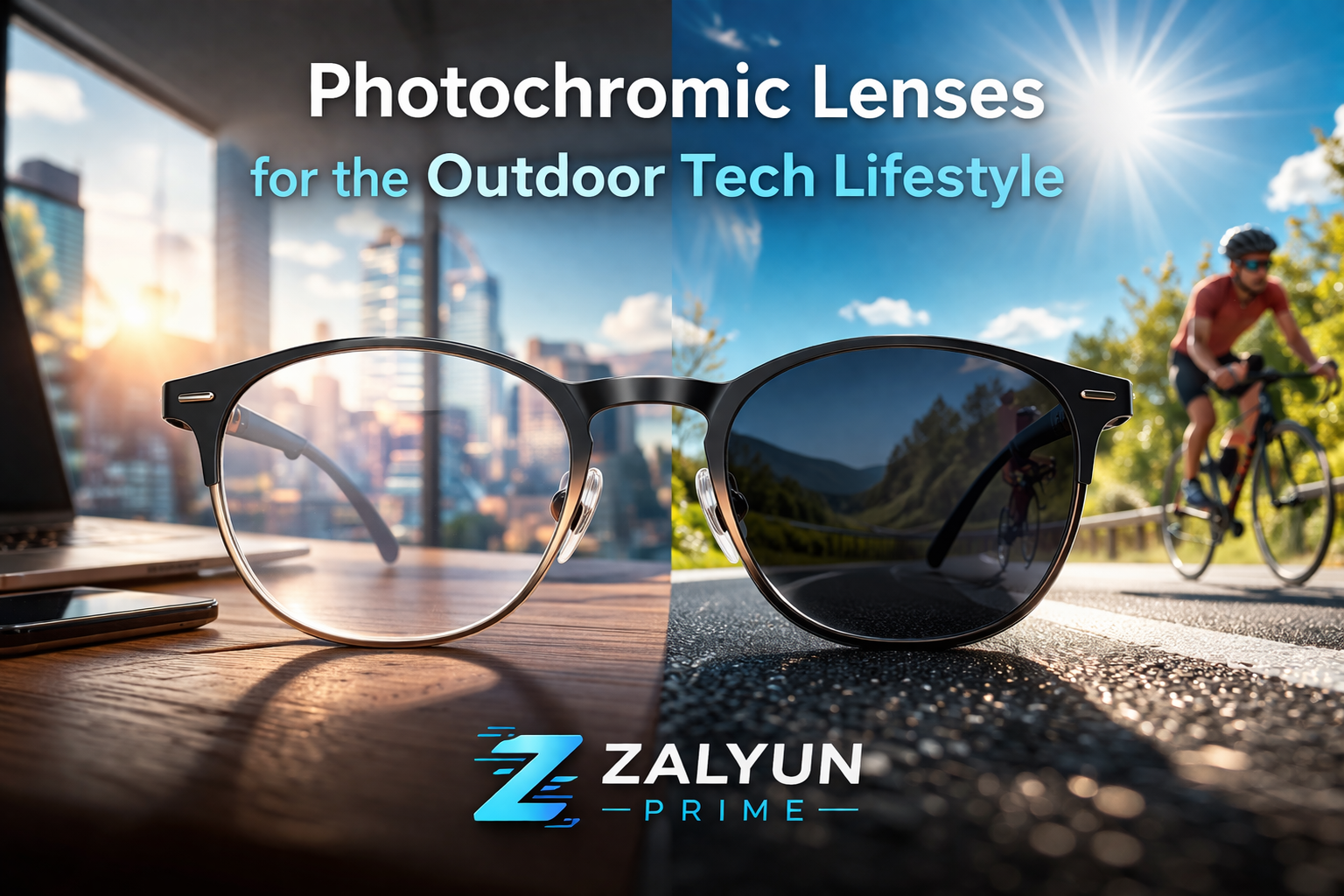
A modern British lifestyle needs more flexible eyewear
Life in the United Kingdom is rarely lived in one lighting condition for long. A person may begin the day checking messages on a phone during a bright morning commute, move into a softly lit office or home workspace, spend hours in front of a laptop, and then head outdoors again for errands, exercise, school pick-up, or an evening walk. In many parts of the UK, even the weather itself can change quickly, which means the eyes are constantly dealing with shifts in brightness, contrast, glare, and screen exposure.
That is one reason more people are searching for eyewear that can adapt to daily movement instead of forcing them to carry multiple pairs of glasses. For professionals, students, commuters, cyclists, creators, and even casual gamers, modern life is no longer fully indoor or fully outdoor. It is a mixture of both.
Photochromic lenses fit naturally into that reality. They are designed to stay clear indoors and darken outdoors when exposed to ultraviolet light. In practical terms, that means one pair of glasses can do more of the work that people used to expect from separate prescription glasses and sunglasses. UK optical retailers describe light-reactive or photochromic lenses as lenses that darken in UV light and return to a clearer state when UV is absent, while some modern lens systems also include built-in blue light filtration.
For readers, this is not just a style upgrade. It is a convenience upgrade, a comfort upgrade, and in many situations, a routine-simplifying upgrade.
Why regular glasses can feel limiting now
Traditional clear lenses still work perfectly well for many people, but they can feel restrictive in today’s hybrid lifestyle. They do not adapt when the environment changes. If the sun becomes harsh, you may need to squint, search for sunglasses, or simply tolerate discomfort. If you wear prescription lenses, that often means carrying a second pair everywhere you go.
This is a small problem that repeats itself all day. You leave the office for lunch. You step out of a train station. You move from a shaded street into direct sunlight. You sit by a bright outdoor café window. You cycle through a tree-covered path and then into open daylight. Each moment creates friction.
For people in the UK, that friction can feel even more noticeable because the day often includes mixed light rather than a single stable condition. One part of the day may be cloudy and diffused, another sharply bright, and another dominated by digital screens. Many people do not need dramatic medical language to recognise the issue. They simply want glasses that keep up with the way they actually live.
That is where photochromic lenses become appealing: not because they are futuristic in appearance, but because they remove repeated inconvenience from ordinary life.
What photochromic lenses actually do
The easiest way to understand photochromic lenses is to think of them as adaptive lenses for everyday movement. Instead of staying the same all day, they respond to light conditions. Boots Opticians explains that light-reactive lenses contain photochromic molecules that change structure in the presence of UV rays, causing the lenses to darken, and then become clear again when UV exposure is removed.
That simple reaction creates a practical benefit: one pair of glasses can support indoor and outdoor use without manual switching.
Some newer lens technologies also combine this adaptive behavior with blue-light-related filtering. For example, ZEISS states that its PhotoFusion X line combines photochromic performance with built-in blue light filtration.
This matters because many users are no longer choosing glasses only for reading, only for driving, or only for fashion. They want glasses that fit an all-day rhythm: work, walk, commute, screen, sunlight, repeat.
Why this matters for people in the UK
1. Commuters need flexibility
A UK commuter may pass through multiple lighting environments in under an hour: house, pavement, station, platform, carriage, office lobby, desk. Switching between clear spectacles and sunglasses in that routine can be annoying and easy to forget. Photochromic lenses reduce that burden by adjusting automatically outdoors.
2. Remote workers do not stay in one place
Remote work sounds static, but in reality it often is not. Many people move from a desk to a garden, balcony, co-working space, coffee shop, or local walk between tasks. Glasses that remain useful in both indoor and outdoor settings support that rhythm more naturally.
3. Students and creators use screens constantly
Students, freelancers, and digital creators often move between laptops, phones, tablets, campus buildings, cafés, and public transport. They do not want bulky routines. They want fewer items to carry and fewer interruptions during the day.
4. Cyclists and walkers need changing-light comfort
People who cycle or walk regularly know that visual comfort changes from one street to the next. A lens that can adapt during movement is especially appealing when the route includes shade, reflective pavement, overcast skies, and occasional bursts of bright sun.
The real strength of photochromic lenses: convenience without extra effort
A lot of eyewear marketing becomes complicated, but the strongest case for photochromic lenses is surprisingly simple: they reduce decision fatigue.
You do not need to stop and ask:
- Should I bring sunglasses?
- Should I switch glasses now?
- Will I need the darker pair later?
- Where did I put my second frame?
- Do I have room for another case in my bag?
Instead, you wear one pair that handles most daily transitions reasonably well.
That is why many people see them less as a niche optical product and more as practical everyday technology. They are not “smart” because they connect to an app. They are smart because they solve a repeated problem with almost no extra effort from the wearer.
Troubleshooting common concerns readers often have
This section is especially useful for both readers and reviewers because it answers real questions clearly rather than overselling the product.
Problem 1: “My lenses don’t change indoors near a bright window”
In most cases, that is normal. Photochromic lenses react mainly to UV exposure, and many modern windows reduce or block much of that UV. So even if the room feels bright, the lenses may remain mostly clear.
Problem 2: “Why don’t they go fully dark in the car?”
This is one of the most common misunderstandings. Standard photochromic lenses often do not darken fully behind a windshield because car glass blocks much of the UV light needed for activation. That does not necessarily mean the lenses are faulty; it usually means the activation conditions are reduced.
Problem 3: “Are they enough for every situation?”
Not always. If someone drives long distances in bright conditions every day, they may still prefer dedicated sunglasses or a lens option built specifically for driving. If someone wants maximum tint all the time outdoors, a traditional sunglass lens may still be stronger.
Problem 4: “Are they too lifestyle-focused and not practical enough?”
Actually, their biggest appeal is practical. They are often most useful for ordinary routines: office work, walking, commuting, school runs, shopping, travel, and casual outdoor use.
When photochromic lenses are a great choice
Photochromic lenses may be a strong fit for readers who:
- move between indoor screens and outdoor light multiple times a day
- want one pair of glasses to do more
- commute regularly
- work remotely from changing locations
- spend part of the day walking or cycling
- prefer convenience over carrying extra accessories
- want a cleaner, lower-friction eyewear routine
They can be especially appealing for people who are tired of the small, repeated hassle of switching between clear glasses and sunglasses.
When they may not be the best choice
Balanced content builds trust, and Google’s people-first guidance strongly supports honest, complete answers over exaggerated selling.
Photochromic lenses may not be ideal for everyone. They may be less suitable if:
- your main need is full dark tint while driving
- you want very strong constant sun protection with no transition delay
- you spend most of your time in one fixed indoor environment
- you need a highly specialised lens for a very specific sports or gaming setup
This does not make them weak. It simply means the best eyewear choice depends on how a person actually lives.
Why this topic works well for a UK lifestyle article
For a UK audience, this topic feels relevant because it sits at the intersection of daily comfort, weather variability, practical fashion, commuting culture, hybrid work, and healthier digital routines. It is not an abstract innovation story. It is a real-world lifestyle story.
People do not need eyewear copy that sounds robotic or over-technical. They need content that helps them answer ordinary questions:
- Will this make my day easier?
- Will I need fewer pairs of glasses?
- Will this suit commuting and outdoor movement?
- Is this useful in the UK, where light changes often?
- What are the limitations before I buy?
That is the kind of clarity that readers appreciate and that search systems are more likely to reward when the content is original, useful, well-structured, and satisfying.
A practical brand mention that feels natural
If readers want to explore modern lens and eyewear options further, they can browse Fatima Optical, whose live site currently features eyewear categories including Blue Light Protection Lenses, Photochromic (Transition) Lenses, and a blog area for related content.
FAQ Section
Are photochromic lenses worth it in the UK?
Yes, they can be very useful in the UK because daily routines often involve changing light conditions, outdoor movement, and mixed weather. They are especially practical for commuting, walking, and hybrid work.
Do photochromic lenses work indoors?
They stay mostly clear indoors. They are designed to react mainly to UV exposure outdoors, not ordinary indoor lighting.
Do photochromic lenses work in the car?
Usually not fully. Standard versions often stay lighter in cars because the windshield blocks much of the UV light needed to trigger a darker tint.
Are photochromic lenses good for screen users?
They can be a practical option for people who move between screens and outdoor environments, especially if they want one pair of glasses for both indoor and outdoor use. Some modern products also include blue light filtration.
Are they good for cycling and walking?
Yes, many people find them useful for walking and cycling because they adjust to changing outdoor light conditions more smoothly than standard clear lenses.
Do I still need sunglasses if I have photochromic lenses?
Sometimes. If you need very dark tint, specialist driving support, or strong sun control for specific outdoor conditions, dedicated sunglasses may still be the better option.